




An AI chatbot is a computer program that uses Natural Learning Processing to interact with users and generative AI to solve queries and automate responses. A 2023 McKinsey report shared that over 70% of businesses were using AI chat apps in customer service operations and seeing a 25% increase in efficiency. As more businesses learn about these perks, it is natural for them to want to adopt AI chatbots. If you, too, are interested in integrating a free AI chatbot into your workflows, take this time to learn about its scope and understand your fit.
What is AI Chat App?
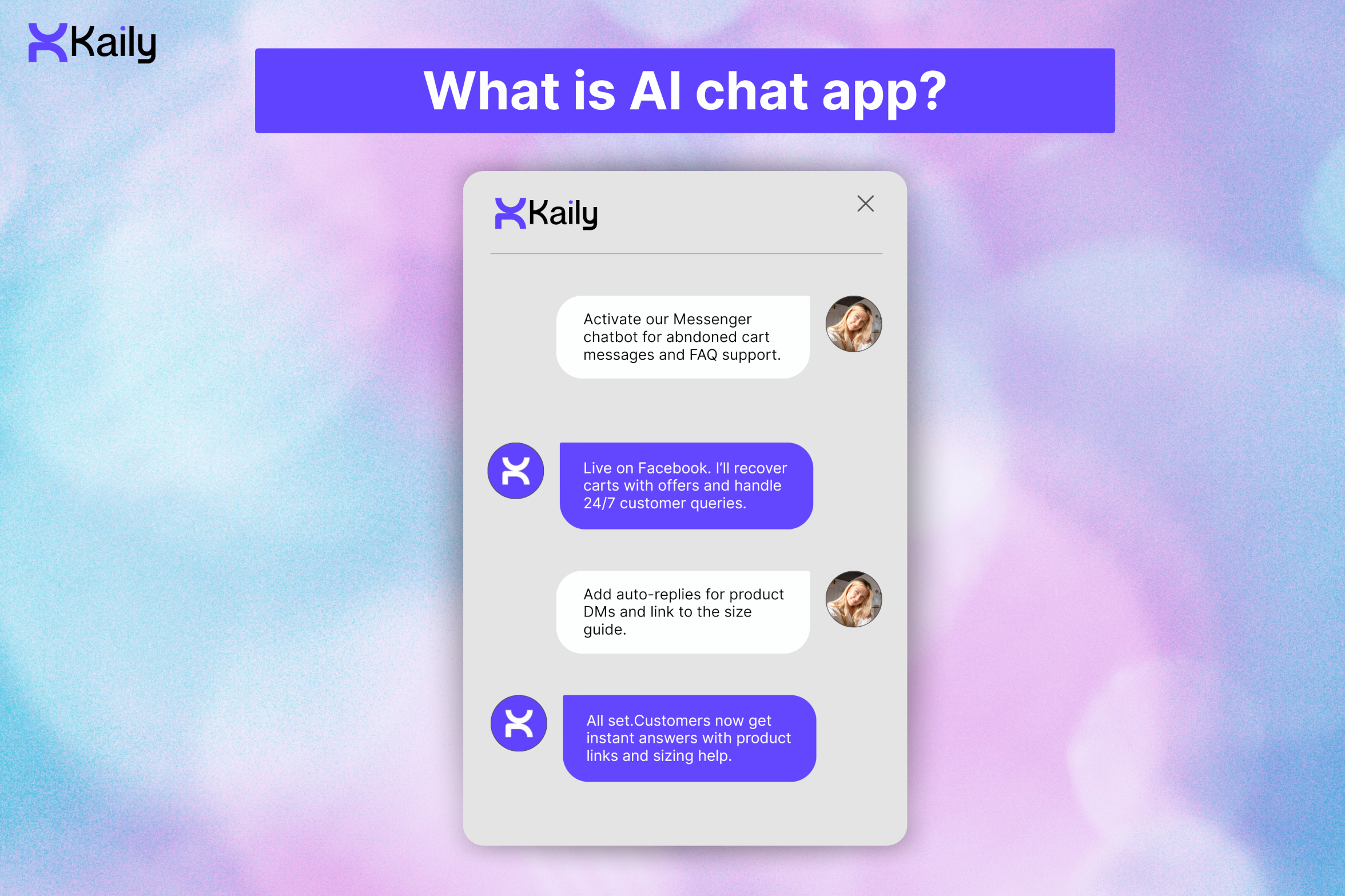
It’s a computer program that uses advanced AI to understand input and respond to what human end-users say in real time. However, the solutions are more than question-and-answer responses and align with your brand voice.
AI chat apps also help automate various business workflows such as customer support services, sales, finance, and other daily operations. Thanks to the growing popularity of AI chat agents, Gartner predicts that AI agents will solve 80% of common customer concerns without human intervention by 2029, leading to a 30% decrease in operational costs.
How Do AI Chatbots Work?
AI chatbots use multiple technologies to operate.
- Large Language Models are neural networks trained on copious amounts of datasets, which help them to understand and generate responses in human language. In this way, LLMs make conversations with AI chats relevant for users and help the systems to learn from user patterns.
- Natural Language Processing is a subfield of computer science and AI that helps computers understand, process and generate human language in both text and speech format. Recent advances in NLP allow AI systems to understand users' questions without the need for extensive retraining, which has improved conversational depth.
- Natural Language Understanding is a phase of NLP that helps interpret user intent and context. It helps chat apps to generate tailored responses and automate complex workflows without human intervention.
- Machine Learning helps AI chatbots to learn from user interactions and improve accuracy and reliability over time. Most AI systems can identify past patterns and resolve common queries no intervention from human agents.
- Semantic Search is a data searching technique that uses an AI-powered matching process to decode prompts and user intent. Subsequently, it helps AI access relevant information or perform suitable actions.
- Sentiment Analysis is a process of analyzing text that helps AI chat apps detect human emotions and context to generate empathetic responses. This technology has been crucial in lowering customer complaint rates.
AI Chatbot vs Traditional Chatbot vs Virtual Agent
Benefits Of AI Chat Apps
The latest AI chatbots on e-commerce platforms can resolve up to 90% of consumer queries in real-time. Studies found that businesses that use AI chatbots saw their response time improve by 35% while experiencing a 30-40% in customer service costs.
Chat apps can handle nearly 70% of routine customer inquiries, which means human agents get more time to focus on complex issues. Additionally, AI chatbots with human-like communication can increase customer satisfaction by 20%.
Platforms such as ChatGPT and Kaily can support interactions in over 70-90 languages, which allows businesses to improve communication through better connections.
Chat apps can manage user requests with little human intervention. This allows human agents to focus on tasks that demand tact, strategy and empathy.
Types of AI Chat Apps
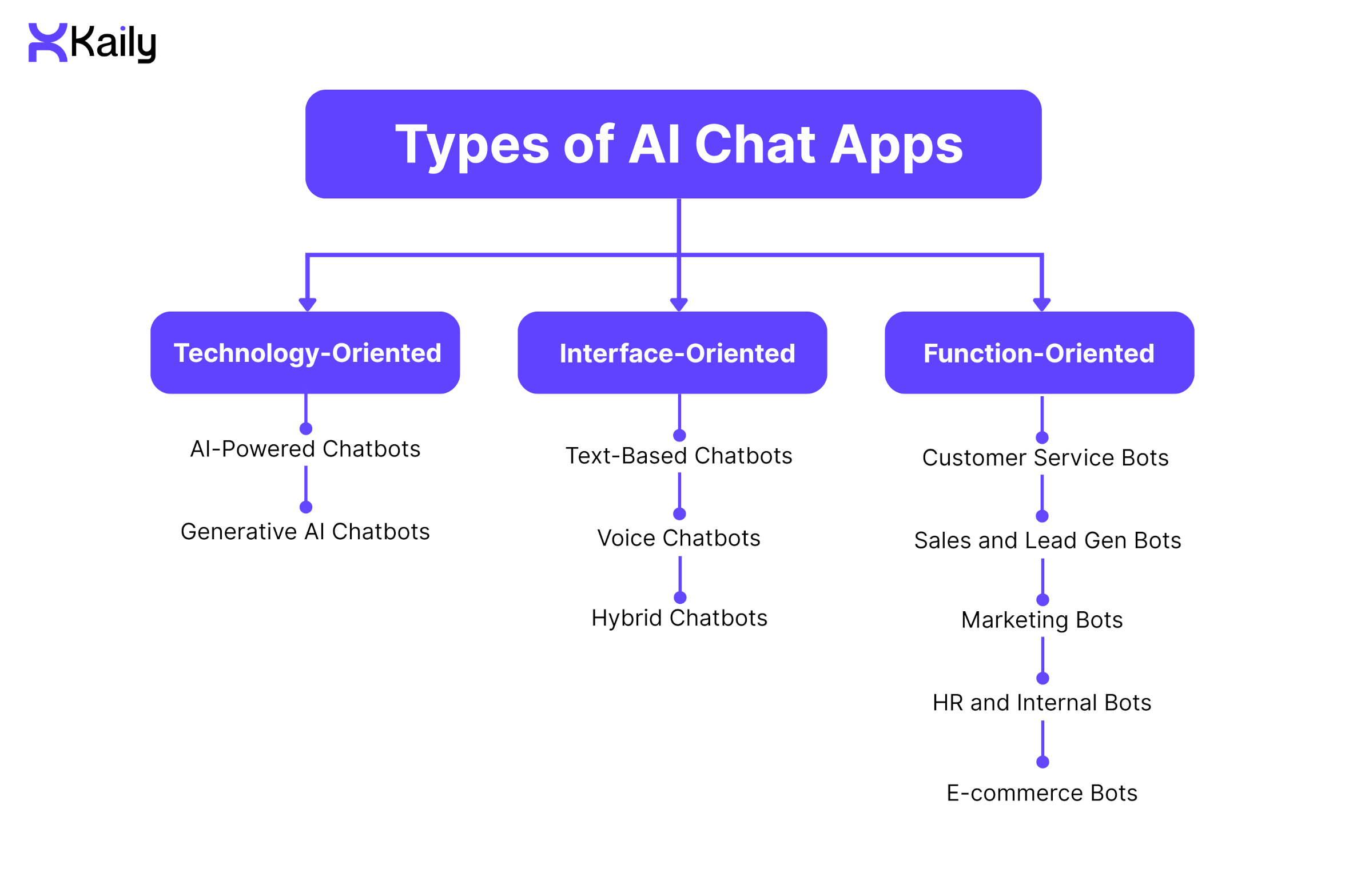
Technology-Oriented
- Rule-Based Chatbots: Have limited flexibility as they use fixed scripts and decision trees. You can use them to answer simple questions that you receive almost on a daily basis.
- AI-Powered Chatbots: Use natural language processing and machine learning technologies to generate responses that are contextually aware.
- Generative AI Chatbots: Use LLMs to create unique, context-aware conversations and offer personalised responses.
Interface-Oriented
- Text-Based Chatbots: It will let your users to interact via web, messaging apps, or enterprise platforms.
- Voice Chatbots: Allow users to use speech to ask questions or solve doubts. Several reports suggest that voice chatbots will dominate the retail and finance sectors by 2030.
- Hybrid Chatbots: Combine voice and text interfaces to offer more versatility and adapt quickly to user preferences.
Function-Oriented
- Customer Service Bots: They answer questions, resolve customer tickets and offer real-time order updates on request.
- Sales and Lead Gen Bots: Qualify leads, book demo requests and nurture sales prospects.
- Marketing Bots: Engage with users during active campaigns, collect their feedback and launch relevant promotions.
- HR and Internal Bots: HR management use these bots to streamline onboarding and automate routine HR queries. A Gartner report found that 26% of HR market leaders are preparing an AI-first operating model, which shows their growing adoption.
- E-commerce Bots: They guide shoppers, respond to their product or service-specific questions and process order transactions in real-time.
Common Use Cases of AI Chats Across Industries
- Customer Support
Customer support teams across industries use AI question answer chatbots to reduce the need for manual intervention. The technology can automate nearly 85% of customer inquiries in retail, telecom and banking services.
- Retail and E-commerce
Retail brands, e-commerce and quick commerce businesses use AI chatbots to handle order updates and handle returns. They also use the AI agent to recommend products to customers based on their preferences and search patterns. Analysis by Mordor Intelligence found that the market size of AI agents in retail and e-commerce reached USD 46.74 billion in 2025 and may touch USD 175.11 billion by 2030.
- Healthcare Platforms
Health clinics and hospitals use AI chatbots to book appointments and screen patient symptoms. These tools also help healthcare units offer health and administrative information.
- Sales and Marketing Departments
They use AI chatbots to qualify inbound leads, boost conversion rates and offer tailored campaigns.
- Banking and Finance Services
AI chatbots assist bankers to speed up their resolution time, manage account-related queries and ensure proper compliance. In 2025, nearly 73% of global banks used at least one AI bot in customer-facing operations.
- HR Operations
HR departments rely on AI chatbots for smooth employee onboarding processes. The bots also help to automate payroll queries and offer quick policy guidance to employees.
- Education
Education platforms use them to reply to admission-related queries. It also helps them to offer personalised admission or administrative support to students.
How AI Chatbots Help Different Business Functions?
Business functions use AI chatbots to achieve these -
Sales Teams use it to:
- Qualify customer leads
- Schedule free demos
- Follow up on sales opportunities
Support Teams use AI chatbots to:
- Resolve customer tickets instantly
- Transfers complex cases for human attention
Marketing Teams use AI chat apps to:
- Automate survey for feedback collection
- Engage prospects - Analyse ongoing campaign performance
Product Teams use AI chatbots
- To gather user feedback
- Automate onboarding process
- Reduce overall time
Best AI Chatbot Apps and Major Features to Check
When comparing popular AI chatbot agents, you must prioritise their key features.
Typically, you must focus on their –
- Multilingual support
- Ease of integration
- Ability to understand context
- Ability to automate
- Privacy control
Comparing these features will offer you better insights and allow you to make informed decisions for your workflow systems.
Myths and Facts About AI Chatbots
- Myth #1:
AI chatbots replace human agents entirely.
Fact #1:
Leading companies combine AI chatbots and human agents to optimise their daily functions. For instance, Bank of America and Amazon implement an AI-human model system where AI agents handle 80% of basic enquiries and human agents deal with complex customer issues.
- Myth #2:
AI chatbots are quite expensive so they are suitable only for big enterprises.
Fact #2:
Free and scalable AI chats such as Kaily.ai, ChatGPT and Perplexity come with free and tiered plans, which makes them accessible to all sizes of business.
- Myth #3:
Chatbots are not empathetic.
Fact #3:
Sentiment analysis and advanced natural language understanding enable AI chatbots to provide empathetic responses that are relevant to the users.
- Myth #4:
Only text bots are important in 2025.
Fact #4:
The global conversational Artificial Intelligence market size will reach 41.39 billion by 2030, which is a jump from 2024's USD 11.58 billion valuation. This growth signals the popularity of voice and multimodal chatbots across both modern and traditional industries.
Due to the associated benefits and scope of growth, businesses across industries are keen on implementing AI chatbots now more than ever. Both new and growing businesses must identify how their workflow can benefit from such integration and plan their next steps to stay relevant in the game.
To make it happen, businesses should consult Professional AI Agent Platforms like Kaily. Their market insights and expertise will allow businesses to make informed choices that support their growth. Talk to Team Kaily to explore AI chatbots for your domain.












.png)

