






AI in customer service uses emerging technologies like Artificial Intelligence, along with NLP (Natural Language Processing), ML (Machine Learning), and conversational AI to assist, automate, and personalise customer interactions across multiple channels (chat, voice, email, etc.). Together, it helps resolve issues faster and at a greater scale than human agents.
AI in customer service is no longer an afterthought. Modern-day buyers want instant answers, personalized interactions, and 24/7 availability across WhatsApp, Facebook, and email. Reportedly, forward-thinking businesses that have embraced AI for customer service have seen significant improvement in service quality, lower average call handling time, and higher customer satisfaction ratio.
Additionally, artificial intelligence in customer service has made it possible for human agents to shift their focus to complex, high-empathy conversations. The industry stats speak for themselves.
- 33% of organizations using Gen AI experienced better first-contact resolution.
- AI support led to about a 30% increase in issues resolved per hour, especially for less-skilled workers.
- Customers are less likely to ask for a supervisor with an upward trending satisfaction graph.
So, as a B2B brand, investing in AI customer service in 2026 should no longer be an experiment but a must-do. This guide will help you understand what AI customer service is, how it works, key benefits, challenges & fixes, and how to select the right AI customer service.
Worried if AI customer service would take months to set up? Book a FREE demo call with Kaily to know how most teams go live in a day without any coding or IT support.
What is AI in customer service?
AI for customer service automates regular time-taking tasks (like creating tickets, routing cases, and generating responses) and reduces average wait time for more first call resolutions. Instead of sending every customer to a human agent, AI agents understand the intent of the query, remember the context, and take the right action.
In short, artificial intelligence customer service combines more than one critical abilities:
- Natural Language Processing (NLP): Helps AI agents understand what customers are actually looking for beyond the keywords they use to search.
- Machine Learning: Improves the response quality over time by referring to real interaction data.
- Contextual Memory: Maintains conversation history across sessions to avoid customers repeating themselves.
- Sentiment Analysis: Detects emotional tone, adjusts the responses, and escalates the case to a human agent if required.
- CRM Integration: Connects with existing tools to access customer records, trigger actions, and log outcomes automatically.
How Does AI In Customer Service Work ?
Traditional chatbots work with a pre-set script and rigid decision trees. But modern AI customer care platforms focus on the intent behind a customer’s message before recommending the next step. Such a model helps resolve interruptions, answer follow-up questions, and offer clarifications naturally.
Once the AI agent understands the intent, every conversation starts to feel natural and supportive. As a result, customers feel heard and their issues are resolved faster.
How AI customer service interactions work (step-by-step)
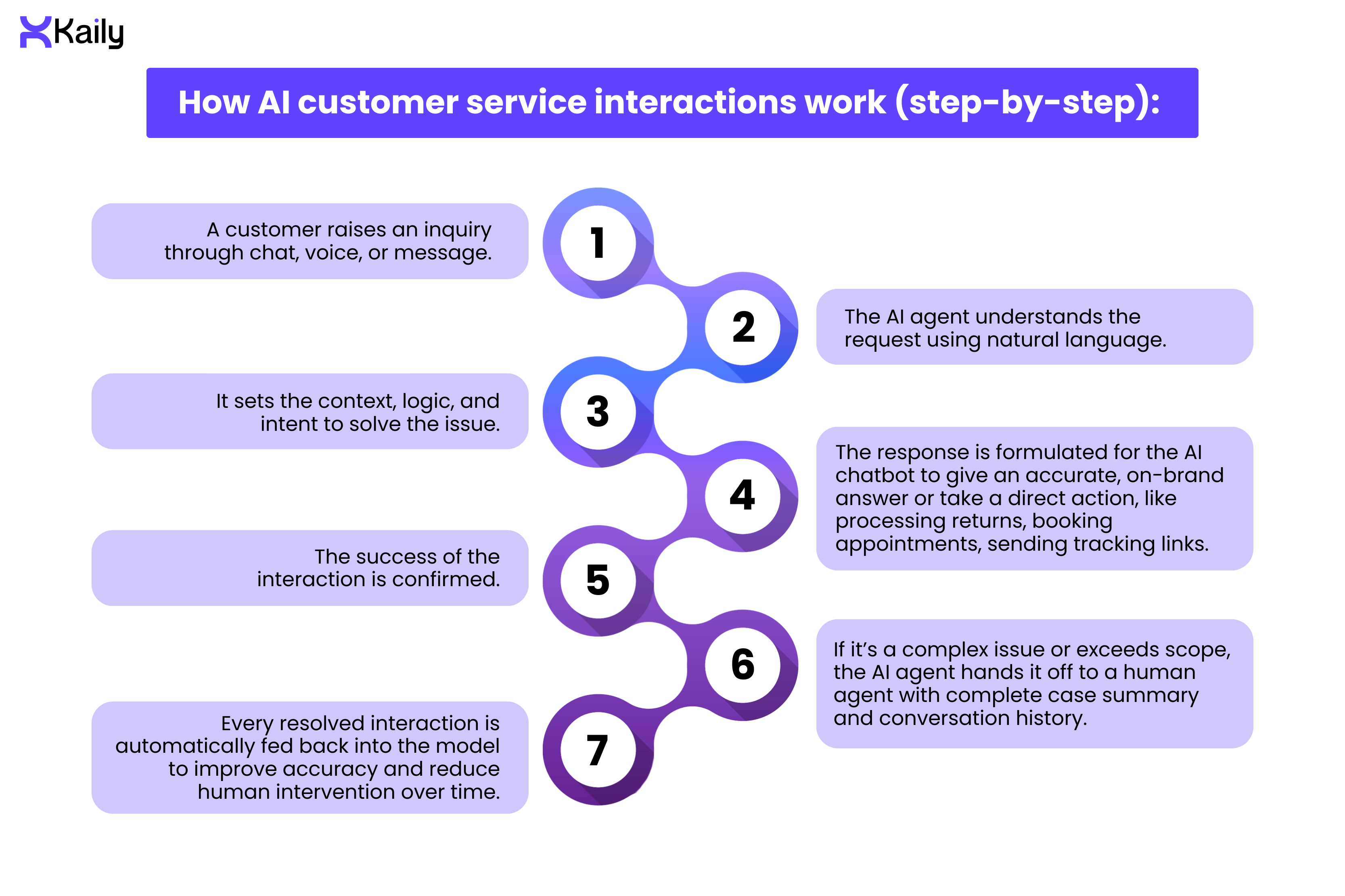
Step 1: A customer raises an inquiry through chat, voice, or message.
Step 2: The AI agent understands the request using natural language.
Step 3: It sets the context, logic, and intent to solve the issue.
Step 4: The response is formulated for the AI chatbot to give an accurate, on-brand answer or take a direct action, like processing returns, booking appointments, sending tracking links.
Step 5: The success of the interaction is confirmed.
Step 6: If it’s a complex issue or exceeds scope, the AI agent hands it off to a human agent with complete case summary and conversation history.
Step 7: Every resolved interaction is automatically fed back into the model to improve accuracy and reduce human intervention over time.
Key Benefits of AI Customer Service For Your Business

AI in customer service helps businesses work faster, smarter, and more efficiently with a host of benefits:
Faster Resolution Times
With AI agents, customers can get their questions answered instantly. This is a sharp contrast when interacting with a human agent where one has to wait in the queue. For high-volume support queues, AI customer care with zero terminal waiting time can win more trust and repeat business.
24/7 Availability Minus Overstaffing
Unlike human agents, AI customer care can operate round the clock across different time zones. There’s no break period cost, complex schedule, or shift allowance to be paid either. That means, customers reaching out on a Sunday evening will get the same attention and service as that of a weekday inquiry.
Low Support Cost With High Throughput
Irrespective of how good an AI customer service is, there are times when human touch is needed. By investing in AI customer service software, you can buy more free time for human agents to deal with complex, sensitive, and high-value conversations. The setup allows for low support cost while still managing to scale customer volume.
Personalised Interactions Means More CSATs
Artificial intelligence customer service stores full context and history of customer interactions. This, in turn, helps the AI agent craft tailored responses to a specific query, like info related to past purchases, outstanding payment issues, or saving one’s preferred channel of communication. Together, it helps make personalisation a default experience for all and no VIP treatment for selected few.
Positive Brand Building and Impact
Every response that an AI agent gives to a customer establishes the tone of voice for your brand. Depending on the query, the AI customer service software can adjust the voice and tone. There is neither a change in mood nor an impact of agent fatigue or experience level. Quality remains persistent throughout from the first message to the ten-thousandth.
Proactive Customer Engagement
AI customer care helps you reach out to your customers even before a dispute is raised over an order. From payment reminders to service appointment confirmation, everything is taken care of. Thus, it adds to the inbound support volume and establishes unique customer standards without human effort.
Actionable Business Intelligence
Every customer interaction generates a good amount of data that AI-powered customer service platforms use to highlight patterns. This includes most commonly faced issues, peak contact times, conditions for triggering escalations, and different customer sentiment trends. Such patterns help the brand, especially the operations, support, and product teams to improve to drive more impact.
Measurable ROI Within the First 90 Days
The returns from AI customer service show up in three places: cost, revenue, and quality.
Cost drops when AI handles routine queries autonomously. Revenue improves because faster responses reduce abandonment and proactive outreach catches at-risk customers before they churn. Quality improves because consistent responses reduce repeat contacts, and fewer repeat contacts lower handle time over the customer's lifetime.
Most businesses see positive ROI within three to six months. The ones that get there fastest start with their highest-volume, most repeatable query types and expand from there.
Real World Examples of AI in Customer Service
Beyond upgrading call center capability and meeting customer queries overload, AI in customer service is at the center of solving real world problems.
Conversational AI Agents
AI customer service agents can seamlessly handle a range of tasks. This includes from answering routine product questions to resolving complex multi-step issues across multiple channels (voice & non-voice). This is a sharp contrast from conventional chatbots that only gave out information. AI agents, on the other hand, understand the nuance, maintain context across conversations, and execute direct actions.
Case Summarisation
Whether it's handing off to a human agent or escalating the call to a supervisor, AI customer care software generates instant case summaries. It contains the necessary details like what the customer asked, what was the intent behind, how was the sentiment, what steps were tried to solve the problem, and what next steps were recommended. Having such details helps a human agent save time and pick up the call without breaking the flow.
Agent Assist
Not every customer interaction can or should be handled autonomously. Agent assist is where AI supports a human agent in real time rather than replacing them. While the agent is in a live conversation, the AI listens, pulls relevant knowledge base articles, suggests response templates, flags compliance risks, and surfaces the customer's full history without the agent having to search for it manually.
The result is faster resolution without removing the human from the conversation. For complex, sensitive, or high-value interactions where customers expect empathy and judgment, agent assist lets your team show up better prepared. A billing dispute that needs de-escalation, a churn risk that needs a retention offer, a complaint that needs acknowledgment before resolution - these are conversations where AI in the background makes the human in the foreground more effective.
Personalised Recommendations
Artificial intelligence in customer service can analyze purchase history of a customer, along with browsing behaviour, and preferences. Once the data is collected, the software makes real-time, relevant recommendations. In other words, AI agents can transform a customer support call into a revenue making window without sounding pushy.
Voice AI for Contact Centres
Voice AI for customer care has been a blessing especially for handling inbound calls at volume. Thanks to its natural ability to understand human speech, ask additional questions to clarify, and when needed route calls with full context. For customers, the entire possession is a lot less frustrating as they don’t have to repeat themselves. As a plus, routine queries, like appointment confirmation or order status check can be solved directly without any human intervention.
Sentiment Analysis and Escalations
AI customer service software readily monitors emotional signals across every live conversation. When frustration or urgency crosses a threshold, it automatically triggers escalations. This helps businesses proactively manage complaints and prevent badwill for a brand.
Automated Queue Responses
Customers waiting in a queue receive contextually relevant automated updates rather than silence or generic hold music. This alone reduces call abandonment rates and improves satisfaction scores measurably.
Knowledge Bases & Self-Service Portals
AI-powered customer service is a perfect option for customers who like to keep it DIY for things like tracking orders, managing subscriptions, and resetting accounts.
Fraud Detection and Transaction Monitoring
AI algorithms can monitor transaction patterns real time, flag anomalies, and therefore reduce fraud. Therefore, it makes an excellent option for any financial, ecommerce, and subscription business.
Multilingual Support
AI customer care can communicate fluently in multiple languages allowing businesses to serve global customers without hiring multilingual human agents.
Surveys and CSAT Automation
It's always good to capture customer feedback when the interaction experience is fresh. AI customer care software allows automatic triggering of CSAT surveys after a successful resolution. Additionally, one can also share feedback surveys on a particular product or service which gives real-time data. This, in turn, helps support teams identify areas that need attention.
Top Areas Where AI customer service delivers highest value

Not every customer interaction needs AI. In fact, the applications of AI in customer service in areas with highest ROI share some common traits.
- Repetitive, high-volume queries, like order status check, login issues, and billing
- Answering customer queries on weekends
- Maintaining consistency for omnichannel communication (WhatApps, emails, live chats, etc.)
- Proactive customer outreach for issues like at-risk purchases, payment reminders, service alerts, etc.
AI Customer Service : Common Challenges And Fixes
AI customer service is powerful, but it needs to be used with care. When set up the right way, it can fix problems faster and make the support process a lot easier. Here’s a look at some common challenges that B2B teams face with AI customer service and possible fixes.
Challenge: Accuracy and Hallucination Risk
AI systems are hardwired to generate confident answers, but sometimes they can be incorrect. This usually happens due to poor configuration and can pose a serious risk across regulated industries.
Fix:
The best way to fix the issue is to disallow AI customer service responses work freely. Instead, ground train its responses with your own verified knowledge base, product documentation, and approved workflows. That’s why Kaily's AI chatbot uses controlled, data-backed responses that give accurate answers.
Challenge: Ensuring Data Privacy and Regulatory Compliance
Businesses are required to have explicit data governance commitments, encryption standards, and audit trails when working with any AI vendor. Therefore, customer data processed by AI-powered customer service systems must comply with GDPR, CCPA, and relevant industry regulations.
Fix:
Invest in a SOC 2 compliant AI customer service software built, especially one that has highest enterprise data privacy standards.
Challenge: Change Management and Team Adoption
While technology is often blamed for underperforming AI implementations, it's actually poor human adoption. In most cases, AI solutions are viewed and feared as a replacement to human agents,which is far from the truth.
Fix:
To address the problem, support teams need to be trained in understanding that customer service AI software is a tool that makes them more effective, not a replacement for them. The high-value conversations that require empathy, negotiation, and relationship-building will always need a human.
Challenge: Integration with Legacy Systems
AI customer care platforms must connect cleanly with your existing CRM, helpdesk, and communication tools. Messy integrations create data silos, inconsistent customer experiences, and agent frustration.
Fix:
Prioritise vendors with pre-built connectors and clean API documentation.
How to Choose the Right AI Customer Service?
The only way to pick the right AI customer service is by asking the right questions. The table below offers a closer look at the key criterion and what you should lookout for.
Why Choose Kaily AI Customer Service?
At Kaily, we've helped 100+ global brands resolve customer queries faster - without months of setup, expensive developers, or enterprise-level complexity. Here's why teams like Abhay's trust us.
- Live in days, not months, no coding or developers needed
- Rated 4.8/5 on G2
- #3 Product of the Day on Product Hunt
- Omnichannel from day one across website, WhatsApp, voice, email, iOS, Android & Slack
- SOC 2 Type II certified & GDPR compliant
Final Thoughts
The bar for customer service has moved and most support teams feel it.
Customers message at midnight expecting an answer. They switch from WhatsApp to email mid-conversation and expect you to keep up. They've already Googled the answer, couldn't find it, and are now one bad interaction away from leaving.
Hiring more agents isn't the answer. Neither is a chatbot that sends them in circles.
The teams handling this well aren't doing anything radical. They picked one problem, usually the query type that was eating the most agent hours, automated it properly, and built from there. Six months later their agents are handling half the volume they used to and CSAT is up.
That's what good AI customer service actually looks like. Not a transformation. Just a quieter queue and a team that's working on the stuff that matters.













.png)


