




In 2026, you have probably already experienced the convenience of speaking into your phone or smart speaker & watching things happen instantly, maybe you asked it for directions, set reminders to take medicine, or even turned the light switch off without lifting a finger. These things come almost naturally to us. They are are all powered by a voice assistant - an AI-enabled helper that listens in to what you say, understands what you want & responds with either an action or spoken answer.
In this guide, we will look through what voice assistants really are through the facets of -
- What a modern AI voice assistant can and cannot do
- How technologies like speech recognition, natural language processing, & text-to-speech work together
- How to tweak voice control & privacy settings on devices
- When it makes sense for businesses to build an AI voice assistant of their own
Think of it as your Voice Assistant 101 guide that has something for everyone, whether you are a buyer or a business looking to create an intelligent personal assistant from scratch.
What is a Voice Assistant?
A voice assistant is a software that you can talk to naturally by giving it instructions like, Call Home, Wake me up at 6, Play a podcast or Turn on the AC - and the assistant then listens, understands your intentions & responds immediately.
You already rely on voice control more than you even realise. For example, when you are driving & ask Siri for directions, the smartphone assistant keeps your hands on the wheel & focus on the road, or when you cook & need a quick timer or measurement conversion, Google Assistant jumps in without you even needing to unlock the phone.
The value you get out of these multimodal assistants is not just convenience but also focus, as you can stay in the moment while your assistant handles the task. Whether you are multitasking, busy, or simply prefer speaking over tapping, a voice-first virtual assistant feels like a personal helper that is ready when you are. A level of convenience that is set to bring voice assistant market revenue up to $33.74 billion by 2030.
Voice assistant vs virtual assistant vs chatbots
We often hear terms like virtual assistant, voice assistant, & chatbots used synonymously, & while they do overlap, each one describes a different way in which you interact with technology. Only when you understand the distinction does it become easier to choose the right assistant for your needs, whether it is for your personal use or business.
A voice assistant is really a voice-first assistant that you rely on mainly for speech-induced tasks that don't involve typing or buttons. A chatbot, on the other hand, focuses on text conversations that guide you through menus or quick replies. A lot of modern systems have started blending both modes so effortlessly that you can barely notice the hand-off. For instance:
- You might start the chat with a critical assistant on a shopping app to check the order delivery status.
- Then speak to the same assistant in your car to ask about the store pickups.
- And after a few days of using that product, you ask the smart home device to reorder the same product.
It is the same intelligence - just delivered through the channel that fits your moment.
Is it a voice assistant AI?
Yes. In fact, this is exactly what makes modern voice assistants so seamless and powerful, especially when you compare them with the earlier generations of voice interface tools/systems. Without AI, a voice assistant remained limited to a list of predefined commands & would ignore any conversation that was beyond the script on which it was built, meaning you would need to speak in preset phrases & even then the system might face trouble adapting to your accent, language, or personal preferences.
At their foundational level, all the top voice assistants - Siri, Alexa, Kaily - depend on artificial intelligence to interpret & extract meaning from natural language & then determine the next best action.
Modern-day AI voice assistants use several advanced techniques that get initiated in real-time the moment you speak, including automatic speech recognition that converts audio into text, natural language processing to understand meaning, dialogue management powered by machine learning to decide what should happen next, & lastly text-to-speech (TTS) functionality to generate responses your customers/you need to hear.
This shift from rules-based processing to machine learning-driven interpretation is the reason voice assistants can now handle tasks like booking appointments, updating schedules, making recommendations, etc. So when you say, "Book a doctor's appointment for tomorrow morning," the system understands that you are referring to an action, which is booking, a person or service, the doctor, & a time frame that is tomorrow morning.
So, is it safe to say that a voice assistant is an example of artificial intelligence? The answer is Yes! Seeing how far AI has evolved - voice assistants are now able to learn from interactions, improve over time, & adapt to the way we speak - becoming one of the most accessible & widely used applications of AI in our everyday lives.
How do voice assistants work?
When you speak to a voice assistant, everything feels effortless - you say what you need & the system responds in a way that tells you it understood you instantly. Behind this simple movement is a carefully orchestrated pipeline that converts your speech into meaning & then into action - all in real-time.
From ‘Hey Assistant’ To Response - The Core Pipeline
Every interaction starts with a wake word. When you say "Hey Google", "Siri", or "Alexa", the assistant shifts from passive listening to active processing, from this point on, several steps happen in milliseconds.
- Your spoken audio is captured & converted into digital signals, which are analysed by automatic speech recognition to determine the exact words.
- The resulting text then moves through natural language processing & intent recognition to understand your goal - whether you want a reminder set, a song played, or your smart light turned off.
- Once the assistant identifies the task, it works with connected services - calendars, home automation tools, or cloud APIs - to execute the request.
- The text-to-speech finally generates a verbal response in a natural tone, which allows you to stay hands-free & focused.
Key technologies that power voice assistants
A majority of the modern voice assistants succeed because multiple AI sub-technologies work together to help the platform give appropriate, accurate responses in real-time.
- ASR (Automatic Speech Recognition) - Converts speech into written text while adapting to your accents & background noise.
- NLP/NLU - Interprets meaning, intent, & context, & not just word patterns.
- Dialogue Management - Chooses the next action by enabling multi-turn conversations that feel extremely organic.
- TTA - Produces clear, human-like responses that improve the listening comfort.
In addition to these, these tools also use deep learning models - including DNNs, RNNs & Transformers - to improve the system’s ability to understand complex phrasing, remember the context over multiple steps & respond in more human-like ways.
Traditional vs AI voice assistants vs generative AI agents
Voice technology has evolved significantly in the last decade. While the early systems were dependent on perfectly phrased commands that offered very little flexibility, evolutions in AI changed the equation by allowing assistants to learn from data, understand natural language, & adapt to our way of speaking. And now, generative AI voice agents are pushing the boundaries even further by giving the software the ability to reason, improvise, & support several multi-step, contextual tasks.
Classification of voice assistants & where they are used
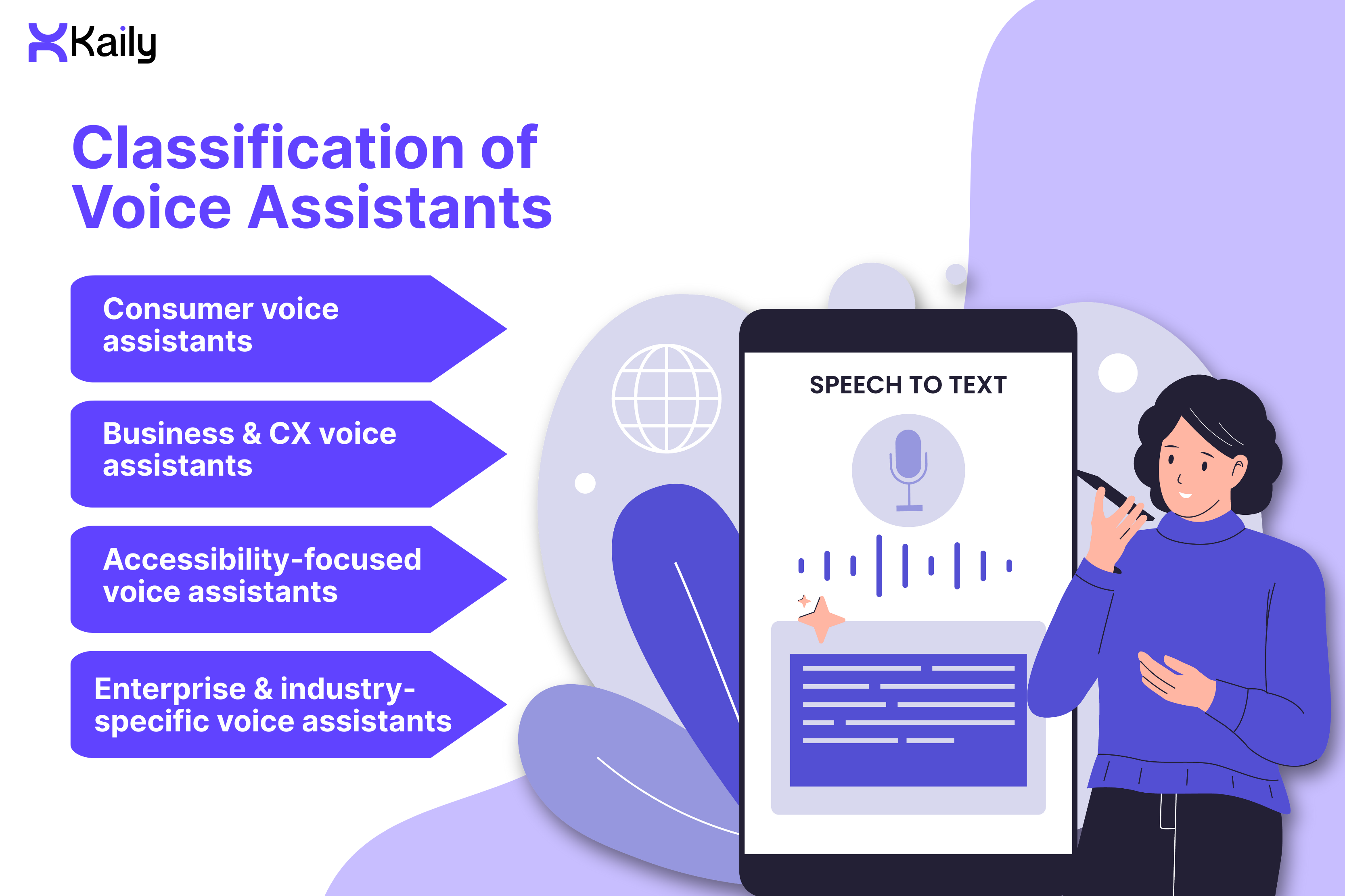
While the underlying technology across different voice assistant use cases is similar, there are multiple categories through which businesses define what they or their customers need. Understanding these categories can reveal the full spectrum of voice assistant use cases - from simple day-to-day tasks to highly specialised industry work.
- Consumer voice assistants
In our everyday life, voice assistants help us move through tasks more efficiently - you check the weather before stepping out, ask for navigation when driving, or control your smart home devices without using your smartphone. This category focuses on convenience - giving you faster access to information & everyday functions with low effort.
- Business & CX voice assistants
Many organisations now rely on customer service voice assistants to support callers in self-service tasks, such as tracking orders, checking account information, or resetting credentials. When applied in a contact centre, these IVR voice assistants, which their market penetration of $5.6 Billion can deflect repetitive queries, provide 24*7 services, & escalate complex requests to agents. This combination does not just improve customer experiences but also reduces the operational load on teams.
- Accessibility-focused voice assistants
For users with disabilities, voice is not just a convenient option; it is a vital accessibility channel through which people with visual impairments can operate devices without screens & those with limited mobility can interact hands-free. Lastly, voice also helps simplify complex sequences into short requests, supporting people with cognitive or learning challenges.
- Enterprise & industry-specific voice assistants
In specialised industries & workspaces, voice assistants streamline professional workflows. For example, healthcare staff can document notes verbally without examining patients, bank employees can quickly retrieve information without navigating their intranet systems, drivers can stay focused on the road by using voice-only controls, & teams can reclaim their time & attention by speaking tasks out loud instead of switching screens or tools.
Benefits & limitations Of voice assistants
Voice assistants are reshaping how we interact with technology by placing spoken language at the centre of our digital experiences.
When a device starts understanding your intention in real-time, daily tasks start feeling like chores & more like small moments of ease, yet, as with every rapidly evolving technology, understanding where voice thrives & where caution is needed will help users & businesses unlock its potential confidently.
Key benefits for individuals
- Everyday convenience & hands-free control
Voice assistants reduce friction by allowing you to speak instead of searching for answers through menus or screens. Whether you are cooking, commuting, or moving through a busy morning, you can ask for what you need & get a reply without breaking the flow. This hands-free approach turns every small microtask into effortless moments & meaningfully reduces the cognitive load throughout the day.
- Productivity that adapts to how you think
Instead of remembering steps or multitasking between different apps, you can simply say what you want to get done. The assistant then takes on all your mental overhead - adding tasks, updating calendars, sending messages, & retrieving information. And because the interaction you have with the tool is conversational, it removes barriers that delay essential tasks & helps you stay organised without any extra efforts.
- Accessibility that supports diverse abilities
Voice assistants & accessibility go hand-in-hand, especially with technology now having the ability to respond to humans' innate capabilities. For individuals with motor, visual, cognitive, & learning differences, voice assistants enable greater independence, so instead of navigating complex touch interfaces, they simply have to speak to perform essential tasks.
- Personalised Support
As assistants learn your preferences, they are able to surface the relevant information faster - your commute, music, habits, search patterns, etc. Because of this, a lot of people experience emotional comfort from having a companion-like agent that shows up the moment they are called.
Key benefits for organisations
- Operational efficiency & cost saving
AI voice assistants are designed to automate high-volume, repeatable tasks across IVR systems, apps, & contact centres. By managing inquiries like order tracking or booking changes, they even lower agent workload & lower the cost per conversation, while teams gain time for complex, emotionally nuanced scenarios where human attention creates real value.
- Faster, always-available customer service
Customers no longer have to wait in queues or wait for the service hours to start since a voice assistant responds to them instantly at any time of the day, irrespective of the time zones. This reduction in efforts - less wait time, zero need to navigate phone menus - ultimately drives measurable improvements in user satisfaction & brand loyalty levels.
- Better data, decisions & personalisation
Every voice interaction captures the context & intent that could get missed in typed conversations. Organisations, when analysing these patterns, can identify the unmet needs, refine knowledge bases, & tailor recommendations. Over time, this leads to the creation of a customer voice assistant that becomes increasingly accurate & personalised.
- Empowered employees in complex environments
Professionals in transportation, factories, healthcare, & logistics sectors are able to retrieve critical information without stopping their work or breaking any safety protocols. In addition to this, voice assistants provide them with hands-free documentation & task management that significantly reduces errors & enhances productivity across critical, manpower-heavy industries.
Limitations, risks & user concerns
- Accuracy challenges
Speech recognition struggles with noisy spaces, accented speech, & certain medical queries. So, when a command is misheard, for example, one that triggers a physical action like unlocking a door, it forces manual correction, which undermines the intended application & benefit.
- Dependency on internet connectivity
Almost all the assistants are dependent on cloud AI services, so when your network fluctuates, the user experience of assistants also drops sharply due to the latency. Even in instances where the connection is strong, apps or devices that were not integrated properly can pose challenges for the AI assistant to produce effective results.
- Discomfort with continuous listening
To detect the wake words, microphones must stay partially active, which many users are uncomfortable with, especially when they have very limited knowledge of the voice assistant's privacy controls.
- Risks Introduced By Generative AI
Advanced voice systems can sometimes produce human-sounding but inaccurate responses, so when an AI confidently offers you wrong information or misunderstands requests tied to payment, vehicles, or smart homes, it opens a Pandora's box of safety & compliance challenges.
Privacy, security & compliance
Since a voice assistant processes & sometimes even stores what you say or type, it is important for the users & organisations to have confidence that their data is managed safely & with their consent. Usually, the audio requests travel to the cloud services where speech recognition, natural language processing, & intent models run, & depending on your settings, these recordings may be saved to improve future accuracy or personalised results.
Noting all the information it can store, practices like clear transparency, simple data-deletion tools, & granular permission controls help users stay in charge of what is kept & what is forgotten.
For enterprises building these bots, the responsibility is even greater as it would mean aligning with all the data protection regulations, establishing clear consent journeys, & ensuring encrypted handling of sensitive queries - this is how they will build trust among people who invest in them.
Voice Assistant Settings - How to Control Your Assistant?
As voice assistants become more capable, knowing how to manage them becomes equally important for you to personalise the experience, improve their accuracy, and increase privacy. The great news is that you have all these settings already available on your devices.
Finding & using voice assistant settings
Although the naming in every device is different, you can start with your device's settings app, then navigate to the section that could be called Assistant or Apps & Voice control. Within that menu, you can adjust the language options, microphone access, wake word preference, & features like personal results.
Turning your voice assistant on or off
There are times when you may want more privacy, fewer accidental activations, or simply a quieter environment - something you can manage in multiple ways -
- Disable the wake word so that the assistant responds only when you manually activate it.
- Turn off the microphone access.
- Completely disable the assistant on a device if you don’t want voice features at all.
With these settings, you can decide how present you want your assistant to be. Some of you may want a hands-free activation in the car but disable it in private spaces, while someone else may need manual control everywhere. The flexibility is there; you only need to choose the level that fits your comfort.
Managing languages, voice & personalisation
Modern-day AI voice assistants are designed to support a growing list of languages & regional variations. You can select the accent & voice style you prefer or switch languages entirely if you speak more than one at home.
You can also create routines - sequences that are triggered by a single sentence. For example, "Good Morning" might have sequences like adjusting the thermostat, reading the headlines, & playing music automatically.
Personalisation gives your assistant more responsibility, but it may also need additional data access, so adjusting those permissions carefully remains essential.
Privacy & data control in settings
To address concerns around permissions and recordings, every major ecosystem now includes privacy tools that help you stay in charge of your data through factors like -
- View what the assistant has recorded recently
- Delete voice history individually or in bulk
- Prevent audio from being stored long-term
- Restrict access to photos, calendar, contacts, & location.
If you have ever wondered, “How do I delete voice assistant recordings?” the answer would usually lie in a section called Privacy, History, or Data Controls under your device’s settings. By taking the time to review & update these controls, you will be able to ensure that the assistant works for you & not the other way around.
Ultimately, voice assistants should feel empowering, not intrusive, & when you understand how to manage the settings, the experience becomes more personalised, secure, & a lot more enjoyable.
AI Voice Assistants for Business - When & How to Use Them?
As businesses advance their digital transformation efforts, voice is emerging as a channel where convenience meets operational scale, especially in the customer experience space. In the CX domain, an AI voice assistant enhances service delivery by providing immediate, conversational support that turns traditional phone interactions into smooth & intelligent workflows.
What is an AI voice assistant in CX?
An AI voice assistant in CX utilises speech recognition, natural language processing, & dialogue management to understand what callers say in their own words & respond with the right action. Instead of navigating the phone menu or waiting for a human agent, customers can simply state their need, like, "I want to track my delivery," & the assistant handles the task instantly.
Common business use cases

- Automating repetitive service requests - High-frequency queries like refund eligibility, order status, & account balance are resolved immediately without queuing, lowering operational load while improving the speed of service.
- Appointment & scheduling support - Voice assistants can update appointments, book services, & manage reservations conversationally to ensure fewer scheduling errors & easier customer coordination.
- Lead qualification - During the sales interest calls, the assistant can capture intent, verify details, & route qualified leads to the right team that would ultimately help close opportunities faster.
- Outbound engagement & reminders - Businesses can proactively reach out to their customers with alerts, reminders, & notifications, allowing quick voice confirmations or callbacks when needed.
- Internal support - Employees get quick help in retrieving knowledge, generating tickets, or accessing system updates, especially in environments where pausing work to type is impractical.
While a smartphone assistant has a direct role to play in improving the business's CX effort, it comes at an investment cost & time that not every business is comfortable with. So, how do you know that your organisation is ready for AI voice assistance?
Real world application of AI voice assistant in Customer Service
A mid-sized ecommerce company handling high volumes of order-related calls introduced an AI-powered customer service voice assistant as the first point of contact in its phone support flow. Before this automation, agents used to spend a large portion of their time answering repetitive queries such as order status, delivery timelines, and return eligibility.
After deploying the voice assistant to handle these routine requests conversationally, the company saw a measurable improvement within weeks. The assistant resolved common queries end-to-end without agent involvement, while seamlessly transferring complex cases to human support. As a result, average handle time (AHT) dropped significantly, because agents were no longer spending minutes verifying basic information. The overall cost per contact also decreased, as fewer calls required full agent attention.
But what was important is that customer satisfaction remained stable - and in some cases improved - because callers received instant answers instead of waiting in queues.
Key Metrics & KPIs to Track
Once you know the definite signs of why you should invest in a voice assistant, the next critical decision that businesses have to make is how to determine whether their investment is even working. Well, the success of voice assistant apps is dependent on a range of KPIs that should be measured clearly for the businesses to then iterate & improve continuously.
With the right metrics in place, voice assistants become a predictable driver of both cost efficiency & service improvement - not just a technology experiment.
How to Choose the Right Voice Assistant Solution?
There are a number of different types of voice assistants - ranging from personal smart speakers to advanced enterprise voice automation systems. The right choice for your business will depend on how you use it, the channels involved, how quickly you need the results, & how deeply the solution must integrate into the existing operations.
For individuals & households
Selecting the right voice assistant at home is about finding one that fits naturally into how you already use technology & not forcing a new way approach that doesn’t seamlessly fit into their routine. Here are a few things to look out for.
- Your existing device ecosystem - A voice assistant will work best for you when it can be connected with the devices you already depend on - phone, smart TV, wireless speakers, etc.
- Smart home compatibility - if you want to control the thermostat, the entertainment system, or appliances using your voice, compatibility will become a key decision factor. The tool you choose should simplify your home & not create a tangle of apps & adapters just to turn on a light.
- Language, accent & family voice profiles - Your app’s users might include multiple languages, accents & shorthand phrases that your family naturally uses. A good assistant should understand these nuances without repeated corrections.
- Comfortable voice assistant privacy controls - Because the assistant is always listening for wake word detection, security & transparency become important. You should be able to review & delete recordings, set permissions, restrict access to sensitive data, & use the device in shared spaces.
- Budget & expandability over time - Many people start with a single entry-level speaker or phone-based speaker and over time expand it to other rooms & smart displays. Choosing a system that supports a flexible, budget-friendly growth path will ensure that you are not locked into a small system that cannot match your needs.
For businesses & product teams
Enterprise voice decisions should support long-term customer experience goals & not act as a one-off technology upgrade that takes up huge initial investment only to prove ineffective later.
- Where are your users - Determining the channels upfront will shape everything else - will your customers interact through mobile apps, phone lines, contact centre IVRs, websites, or physical kiosks? Each of these environments will have a different expectation attached to it.
- Integration with core business system - true value comes when a voice assistant does things - retrieve balance, check order, reschedule services - & not just answer questions. Ensuring this would require secure connections to CRMs, booking engines, payment gateways, & authentication tools, etc.
- Scalability & peak-load performance - Seasonal spikes, product launches & service outages - generate sudden increases in the call volume. A robust solution should scale automatically so that the customers get an immediate response even when the demand surges.
- Analytics & continuous improvement - Voice is rich with data, as every single utterance reveals intent. The platforms must provide dashboards that help teams measure automation containment, customer sentiment, recurring problems, & optimisation opportunities.
- Security posture & compliance readiness - If your assistant handles payments, healthcare data, or personal identifiers, it should operate under strict security & data handling frameworks.
While the decision is fairly straightforward for individuals who need an AI voice assistant for their routine, everyday needs, things become complicated for businesses, especially those in their scaling stage. Growing businesses often have very particular needs, which can be difficult for one IVR voice assistant or smart display app to match, making it critical for them to choose between Buy and Build.
Build vs Buy - Deciding Your Path
Businesses must evaluate whether they need rapid deployment or deeper control over the assistant's capabilities - a decision that becomes all the more difficult since buying a pre-built solution accelerates time-to-value while building offers more customisation for strategic differentiation.
To make the decision-making easier, many businesses adopt a hybrid strategy - start with a buy-first approach to prove value & later build out the customisations that would refine the brand identity & competitiveness.
How to Build an AI Voice Assistant?
Thanks to modern APIs, SDKs, & low-code platforms like Kaily, building an AI voice assistant today doesn’t require much technical know-how or a huge investment. Whether you are integrating voice into an app or deploying a smart IVR for customer support, the building blocks are similar.
Let us talk about them one by one.
Core components you need
- Voice capture & Wake word detection - Everything starts with an audio input for which the assistant constantly listens for a wake word - Alexa, Siri, etc. or can be manually activated on the devices.
- Automatic Speech Recognition - ASR converts spoken language into text that the system can interpret. While the traditional systems struggled with accents or complex phrasing, modern deep-learning-based systems are designed to handle conversational speech more reliably.
- Natural Language Understanding - Once converted to text, the platform must study the meaning of the interaction - identify user intent (check balance) & relevant entities (Savings account). The smarter your NLU, the more intelligent your assistant will feel.
- Dialogue management & Decision logic - This layer would decide what the assistant should do next - provide an answer, ask a clarifying question, call an API, or escalate to a human. It does that by maintaining context across multi-turn conversations so that every response feels personalised.
- Backend integrations & Action execution - Connecting to billing systems, CRMs, booking tools, or IoT devices is what enables real action. Without these integrations, the voice assistant remains a Q&A tool.
- Text-to-Speech - The response must come back in a clear, natural voice. Today’s neural TTS engines offer expressive variations - tone, speed & personality - allowing brands to build assistants that feel trustworthy & consistent.
Modern development platforms work around all of these components through a clean, accessible interface so that the team is able to focus on experience design & not rebuilding foundational AI from scratch.
The steps to build voice assistants
The steps for building your own voice assistant will vary from one no-code tool to another. But what would remain the same is the development flow. Here is a visual to explain the journey.
- Define the Primary Use Case - Identify the top tasks users want to complete by voice.
- Design Conversational Flow - Create clear paths for task completion while planning for variations in how users may phrase their requests.
- Choose technical stack & ASR/NLU vendor - Decide whether you will use cloud APIs, no-code tools or a custom model based on language requirement, data sensitivity, & scalability goals.
- Collect utterances & user data - Representative voice samples will help train or refine your models to understand your audience & terminology better.
- Build, test, refine - Test again - Voice UX can improve only through iterations - analyse where your users get stuck, refine responses & expand intent based on real-world interactions.
- Optimise continuously post-launch - Voice assistants are not a one-time effort. They improve with monitoring, learning from failed attempts, & adapting to new needs.
Where can voice assistants be integrated?
Your voice assistant can (& should) live almost anywhere users need answers.
- Mobile apps & web interfaces for helping customers handle tasks without tapping through menus or calling a sales/customer representative.
- IVR system in a call centre for replacing 'Press 2 for billing' with 'Tell me what you need' - removing complexity & reducing the call wait time.
- Smart devices & IoT
Cars, fridges & appliances that respond to voice - making technology useful in moments where hands & eyes are occupied.
Guardrails, governance & human hand-off
A responsible voice assistant is built to 'know its limits'. It should recognise uncertainty, ask clarifying questions or escalate to humans where empathy, reasoning, & compliance call for the switch.
In addition to this, following governance frameworks would ensure the system is able to follow rules & legal requirements, especially when handling payments, verifying identity or giving medical information.
In both cases - Governance & Responsible Assistant, continuous monitoring, regular audits, & prompt model retraining will be needed to avoid outdated responses, hallucinations, & failires that frustrate users. After all, adopting voice means adopting a mindset of responsible AI, where automation empowers, not overwhelms.
The Future of Voice Assistants
The global AI assistant market size was estimated at USD 16.29 billion in 2024 and is projected to reach USD 73.80 billion by 2033, growing at a CAGR of 18.8% from 2026 to 2033. What this shows is that voice is evolving into a primary interface for the digital world. As AI advances, assistants will become more proactive, contextual & seamlessly embedded across our environments - almost invisible but always ready to help.
- Multimodal & ambient assistants - The next generation of assistants will be seen moving beyond single-device interactions. In the coming time, you will start a command on your phone, continue the conversation through your car display, & finish it on a smart speaker at home - without repeating yourself.
These ambient AI systems will combine voice with gestures, visuals, & sensor data to understand what you want even though you didn't mention it explicitly.
- Generative AI & human-like conversations - With the help of generative AI, assistants will be able to understand nuances, ask clarifying questions, & tailor the responses to your context & tone. So instead of memorising commands, you will speak the way you naturally do in any conversation. For example, saying "I am travelling next week - remind me to water the plants before I leave & order groceries when I get back" will automatically tell the assistant which trip you are referring to, what days you are home, & your usual grocery order.
- Increased personalisation through long-term memory - Today's assistants barely remember what happened five minutes ago, but the future assistants will be built on secure, permission-based long-term memory that adapts to your preference over months & years. They will also understand routines, anticipate needs before you ask, & even surface recommendations that feel genuinely helpful.
- Local processing & privacy-first architecture - Voice assistants are beginning to shift more intelligence to the device itself, which means faster response time, fewer network failures, & stronger voice assistant privacy so that your sensitive information does not leave the home or workplace. Soon, you can expect a greater number of offline-capable assistants that can execute commands, control devices, & answer queries without cloud dependency.
- Regulation, ethics & trust - As voice assistants become more proactive, expectations around consent & transparency will grow manifold as users demand clear disclosures about when their microphone is active, where the recordings are stored, & how the tool is making automated decisions. Additionally, regulations will continue to define rights around voice data, especially in sectors that deal with identity, health, & payments.














.png)


