






If your team is dealing with rising customer expectations, heavy workloads & rising pressure to deliver faster results with very limited resources, you are seeing the same pattern most businesses are navigating in 2026. They too are witnessing increasing consumer demands but their operational capacity, team size & budgets are rarely scaling at the same rate.
This imbalance is pushing leaders, like you, to find practical ways to maintain responsiveness without adding any external overhead. A space where AI chatbots are proving their value.
With the market size standing at $27 billion, across industries, businesses are using AI chatbots to stabilize their service delivery, reduce repetitive workloads, guide customers through the sales funnel & support internal teams at every step.
Why? Well, instead of working as a simple FAQ responder, chatbots are assisting users with lead qualification, purchase guidance, routing & real-time updates.
For a lot of companies, this extended scope that AI chatbots offer has become a core differentiator. When your customers or employees get instant AI answering - regardless of the platform or time zone - it reduces friction across the entire journey making chatbots one of the most cost-effective & high impact tools available in the market. Tools that don’t just assist users who reach out, they improve internal workflows, lower your wait times & create a predictable service environment that maintains momentum even during pressure cycles.
In this article, we will explore how for organizations navigating competitive, complex markets, the benefits of chatbots extend far beyond automation & the things that they should know to make the most of these immersive technologies.
What is a Chatbot?
A chatbot is an automated system that interacts with users through voice or text to deliver information, streamline communication & execute tasks. What started off as a simple FAQ-based tool, in 2026 chatbots range from rule-based tools that follow pre-defined scripts to AI-driven conversational agents that are capable of understanding intent, analyzing context & adapting responses in real-time.
All these modern-day chatbots are designed to be integrated into service desks, CRMs, knowledge bases & internal systems - which allows them to pull data, submit requests, trigger workflows & deliver consistent, fast answers. Whether deployed on a website, inside a mobile app, or platforms like whatsApp, Slack or Teams, chatbots have become the essential operational layer for organizations that are aiming to reduce friction & improve service availability.
What makes them particularly valuable today is the ability they carry to operate across multiple touchpoints without losing context. For example, a customer might start a conversation on the website, take the dialogue on the mobile app & then complete it on a messaging platform like WhatsApp - all without losing continuity.
This multi-channel compatibility supports businesses that work with the single objective of meeting users where they already are & not force them into unfamiliar systems.
Benefits of Chatbots for Businesses

- Improved customer service
Chatbots elevate customer service by giving people something they value most - speed & availability.
With its 24*7 availability that allows employees & customers access to support, bots become valuable for global teams & multi-timezone operations. The instant replies that these platforms make possible, reduces frustrations & wait time, while the ability to manage multiple inquiries simultaneously eliminates all the bottlenecks in the peak hours.
This instantaneous availability becomes especially important when customer-facing teams find themselves in the middle of unexpected spikes - outages, product launches & seasonal demand. Over time, this builds a predictable service standard & reduces exposure to service delays that damage satisfaction.
- Cost efficiency & reduction
One of the strongest benefits of chatbots is cost efficiency. By automating all the routine inquiries, businesses reduce operational costs, cut down on the staff & prevent teams from being overwhelmed by repetitive work - events that lead to chatbots helping reduce customer service costs by over 30%.
Chatbots also reduce average handling time by gathering information upfront & offering immediate solutions. Most importantly, they allow businesses to scale without any cost increase as the bot is able to absorb high inquiry volumes without any significant overhead.
From budgeting point of view, this situation builds in long-term predictability where instead of expanding the teams every time your demand increases, companies are able to maintain a leaner operational model while meeting their service goals.
- Increased productivity
Chatbots help teams regain productive hours by automating their repetitive tasks like onboarding steps, accounting queries, order checks & basic troubleshooting, freeing human agents to focus on complex issues that are dependent on their problem-solving skills. Ultimately, this reduced repetitive workload leads to lower burnout & higher employee satisfaction that allow teams to contribute to higher-value business objectives.
- Enhanced customer engagement
Chatbots support proactive communication by sending alerts, reminders & tailored suggestions based on user actions. By delivering personalized interactions through contextual data, guidance becomes more relevant. Moreover, its multi-channel functionality helps customer experience teams maintain consistent messaging across web, mobile apps, social media & messaging platforms - leading to higher engagement rates.
Businesses are increasingly using chatbots to deliver engagement moments at the right time. For example, when a customer visits a pricing page the chatbot can offer additional information, clarity or targeted incentives & once they leave the website, they get push notifications or ads of the products. These timely nudges improve conversions without making the experience intrusive.
- Data collection & insights
Gathering real-time valuable data from conversations - preferences, behaviour patterns & issues - becomes easier with chatbots. These datasets are then used by businesses to analyze customer behaviour, pain points and translate them into improved products, workflows & policies.
Over time, these insights reveal patterns that humans would miss - frequent confusion around features, rising interest in a product line, or recurring friction in the onboarding process. These discoveries support decision-making across marketing, product & service teams.
- Sales and lead generation
Chatbots help businesses qualify leads automatically by asking relevant questions & measuring readiness. They are used to guide customers through the sales funnel with tailored suggestions & concerns resolution, something that helps with cart recovery, reducing dropoffs & enabling cross-sell, upsell flows with contextual recommendations.
When integrated with CRM systems, these chatbots update lead records, tag user intent & categorize opportunities in real-time. This significantly reduces the manual efforts of the sales team while speeding up the follow-up cycles.
- Scalability
Unlike human teams, chatbots scale instantly & effortlessly handle traffic spikes, support global expansion & process thousands of conversations in real-time without dropping quality. And since there are no capacity limitations, businesses can grow confidently without thinking about resource strain or infrastructure requirements.
This scalability, translates into a competitive advantage in high-impact periods like product launches, campaigns, ordering waves or sudden demand shifts.
Industry-specific Benefits of Chatbots in 2026
If there is one aspect that ties every sector - traditional like Health, Real estate & modern like Fintech, Edtech - it is ensuring customers’ needs are met in real-time. Something that AI chatbots are making possible with minimal investment.
- Retail & ecommerce
In the retail space, chatbots are able to help businesses offer tailored experiences by delivering product recommendations, helping customers assess products & providing quick answers that would eliminate hesitation during checkout.
They also support order-tracking by retrieving real-time updates instantly, removing pressure from the customer support teams while also playing a crucial role in abandoned cart recovery, re-engaging potential buyers who left mid-transaction.
Lastly, when customers require assistance, chatbots become instantly active & help them with returns, refunds as per the policies.
- Healthcare
Healthcare providers have grown to depend on chatbots to streamline patient communication, simplify appointment scheduling, reducing administrative workloads & support adherence by sending medication reminders.
A lot of healthcare providers are also implementing bots for patients’ initial symptom assessment, helping them direct the patients to the right care provider team. During increasing patient volumes when the healthcare staff face increasing pressure, chatbots act as an additional communication layer that helps with patient data collection, reducing paperwork & improving accuracy.
- Banking & Financial Services
In finance, chatbots improve speed & transparency by enabling customers to instantly check account balance, review transaction history & request information without waiting for an agent.
These tools help banks enhance security by sending out fraud alerts & allowing customers to verify activities actively, while for lending operators, they simplify the loan application process by guiding us through eligibility, documentation & approval processes.
Financial institutions also benefit from reduced operational costs, as a lot of inquiries, especially transactional - are repetitive and high-volume in nature. This way, chatbots are able to offer a reliable way to manage response speed while meeting strict regulatory standards.
- Customer Service
Chatbots strengthen service operations by providing assistance with ticket deflection & solving issues without human agents’ involvement by offering users first-line support, handling queries & guiding them to the right team.
Through this high-level FAQ automation, routine inquiries get addressed instantly & the moment human intervention is asked by the users, chatbots enable easy agent handoff with complete context, ensuring seamless continuity.
This combination ultimately reduces queue lengths, improves CSAT & gives support teams the bandwidth to focus on more complex issues.
- IT & HR
Internal teams use chatbots for employee onboarding, providing all the new hires with policies, workflows & step-by-step guidance. These bots also deliver instant access to policy information that reduces administrative workload while supporting technical troubleshooting & assisting employees with common issues.
In large organizations, bots help simplify leave management, handling requests, balances & approval efficiently - automation which saves thousands of hours annually & create a consistent employee experience.
- Real Estate
Real estate organizations use chatbots to make product discovery easier through streamlining of property searches, capturing buyer preferences & offering curated options.
The sales team also benefits from chantbots handling lead qualification, gathering details before they step in.
Chatbot Types & Capabilities
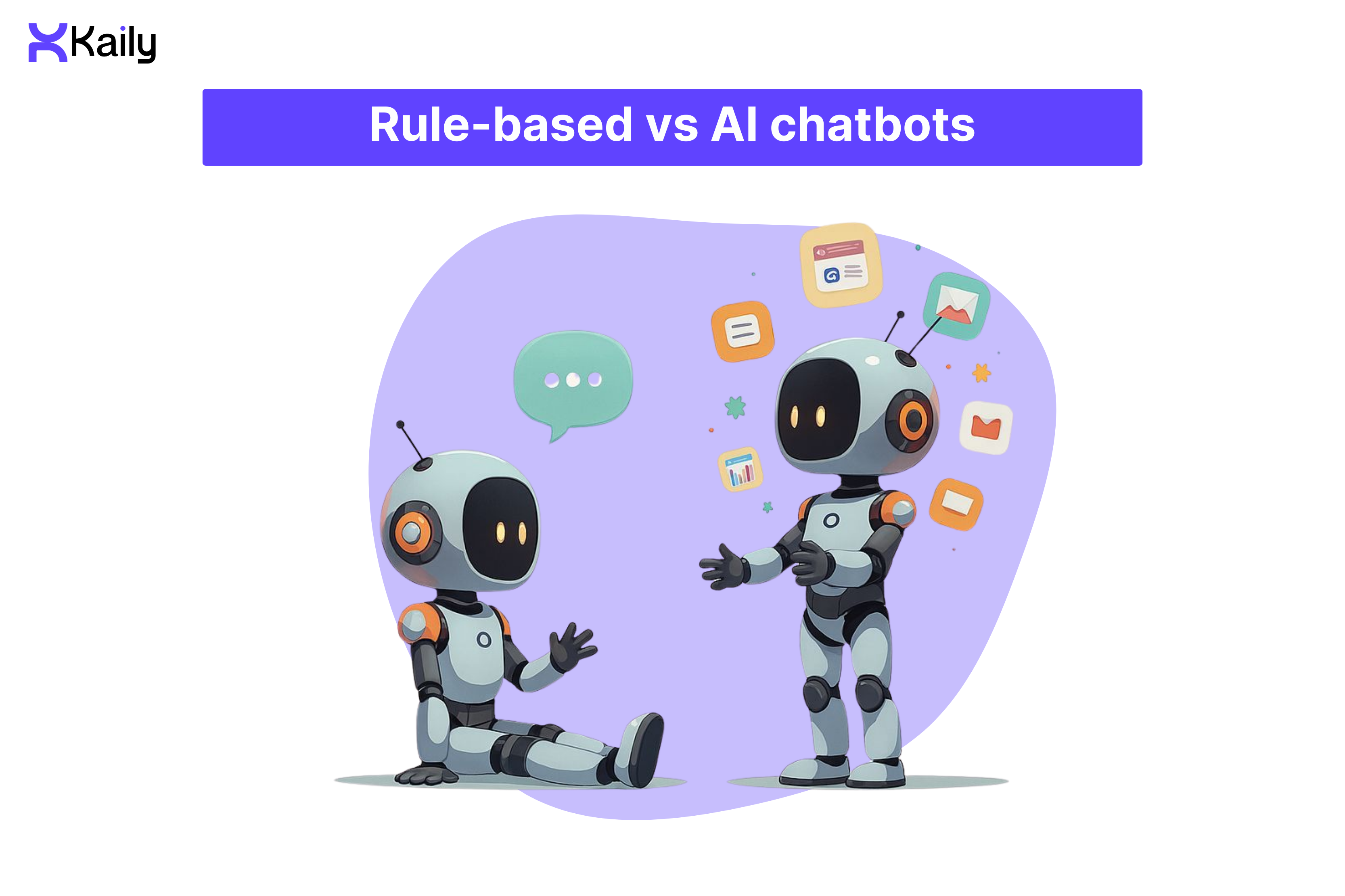
Understanding the major chatbot types & capabilities will help businesses select the right approach for what efficiency, cost & customer experience looks like in 2026.
Rule-based vs AI chatbots
Rule-based chatbots are designed to follow a pre-defined logic, decision tree & scripted response, which tend to work best with structured, predictable workflows like FAQ, status updates, appointment bookings & policy lookups. Because they operate inside a fixed parameter, they are able to offer higher levels of control, consistency & compliance - making them an ideal choice for regulated industries or transactional environments.
AI chatbots, powered by NLP, NLU & machine learning interprets open-ended questions, understands context & adapts their responses. This doesn’t just enable handling of complex & varied inputs but also make them ideal for tasks like sales qualification, IT troubleshooting & multi-step decision support.
When to use which.
- Use Rule-Based chatbots when all your workflows are linear, predictable or require strict control.
- Use AI Chatbots where you know the interactions would differ widely or the system will need to have a deep-level contextual understanding.
- Use Hybrid Chatbots when you need both structure & flexibility. Here, AI can handle understanding while rule-based bots can govern compliance, escalations & decision-habits.
Key technologies
- Natural Language Processing to interpret users' messages even when there are spelling errors & informal language.
- Natural Language Understanding to extract intent, meaning, context & entities.
- Machine Learning to create patterns from past conversations & trends to improve accuracy.
- Large Language Models to generate more human-like, organic responses.
Together, these technologies are able to create a system that is capable of handling diverse, high-volume interactions with precise adaptability & accuracy.
Advanced Features
- Sentiment analysis that identifies user emotions & adjust tone
- Intent detection for routing queries & triggering workflows
- Context awareness to maintain continuity across multi-step conversations
- Continuous learning to improve responses & lower down all the manual adjustments.
These capabilities help chatbots transform from simple scripted tools to intelligent digital assistants.
How to Implement Chatbots?
Implementing a chatbot that understands its users - intent, context & query - requires a clear strategy, strong decision & continuous optimization. Businesses that follow a structured implementation approach see higher adoption, better accuracy & a higher ROI.
Define Your Objectives
Start by identifying your main goals - lowering support load, improving response time, enhancing customer experience, qualifying leads, or streamlining internal operations.
Setting clear objectives would help determine the type of bot, required integrations & the KPIs to measure.
Choose the Right Platform
Select a platform on the basis of -
- Integration options
- Workflow automation capabilities
- Scalability
- Security & compliance
- Multi-lingual support
- AI support.
Lastly, the platform should fit seamlessly with your existing ecosystem & support its future growth.
Design the Conversational Flow
Designing an effective dialog flow would require you to map out user journeys, identify their exact intent, define the escalation rules & structure all the fallback responses.
The goal is to make user interactions smooth, predictable & efficient, in order to minimize friction for users while maintaining consistency in replies.
Train & Optimize
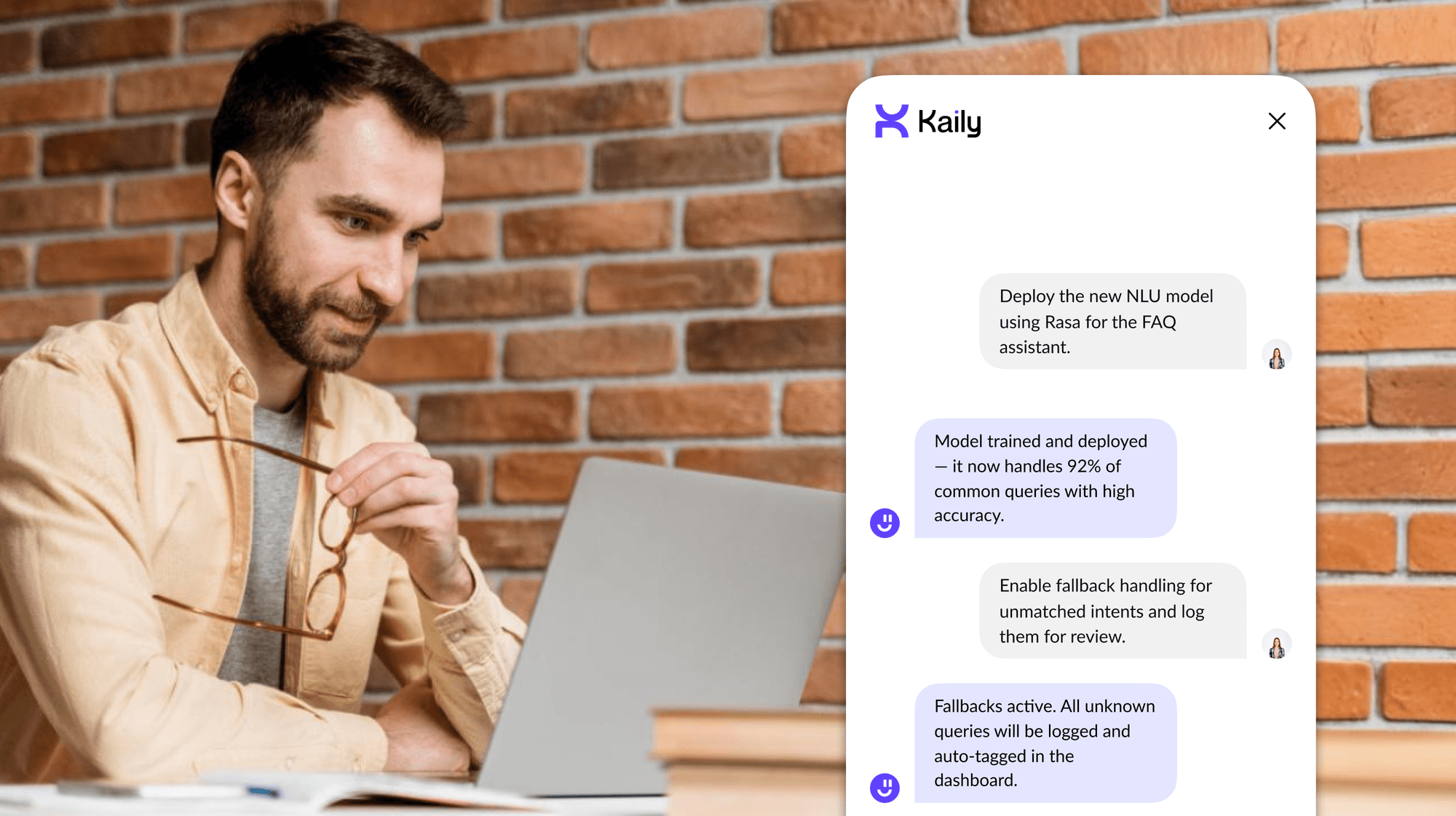
Train your chatbot with the help of real customer queries, support logs & historical data. To make the training a lot more effective, try and incorporate in different phrase variations, industry terms & the mistakes that your users commonly make.
Once your chatbot is trained, extensive training should be done to ensure that the bot is able to handle the edge cases, understands user intent & maintains accuracy across different scenarios and channels.
Monitor & Optimize
After deployment, continue refining by -
- Reviewing unresolved & misunderstood queries
- Updating flows with new intent patterns
- Monitoring satisfaction scores & drop-off points
- Aligning responses with new policies, processes & products
- Adding new capabilities as the new business needs evolve.
Making continuous improvement in chatbots will ensure that they remain effective & reliable even as the market and user expectations change.
Future of Chatbots
With every AI update, chatbots are also evolving. In 2026 and beyond, we can expect chatbots to act less like scripted support tools & more like digital co-workers that help businesses learn faster & leaner.
- AI & Generative AI Advancements
Chatbots will become more capable as generative AI & LLMs advance. With 88% of companies now using AI in at least one business function, chatbots will also handle multi-step tasks, generate content & access enterprise data to deliver contextual answers.
- Human-like interactions
Conversational quality will improve dramatically with new models allowing chatbots to interpret our tone, build memory & adapt responses based on our personality. There has been research that shows up to 87% of businesses see measurable improvements in customer satisfaction after deploying chatbots.
- Emotional awareness & context awareness
Future chatbots will detect sentiment & proactively adjust its tone or escalate the matter to humans. With the global chatbot market projected to grow significantly in the years ahead, companies will start investing in bots that understand nuance & not just keywords.
- Integration with IoT & other technologies
Chatbots will increasingly connect with RPA systems, IoT devices & enterprise apps. This would allow automated workflows, for example, chatbot pulling sensor data to schedule maintenance or trigger system updates whenever issues are detected.
Conclusion
In 2026, businesses will see the benefits of chatbots ranging from efficiency, scalability, cost saving & improved customer, employee experience. With teams aiming to attain real-time responsiveness in an increasingly competitive landscape, chatbots are helping them operate more efficiently, reduce their workloads & deliver consistent service levels at scale.
For businesses that are evaluating automation strategies, chatbots offer a practical, high-entry point that addresses immediate challenges while laying the foundation of long-term digital transformation.
This marks today the best time to consider implementing chatbots as part of the operational strategy. As the technology continues to evolve, companies that adopt early will stand to gain the most in insight, performance & customer satisfaction.
Interested in exploring fresh new chatbot platforms? Talk to us at Kaily and learn why Kaily should be at the top of your list!











.png)

