





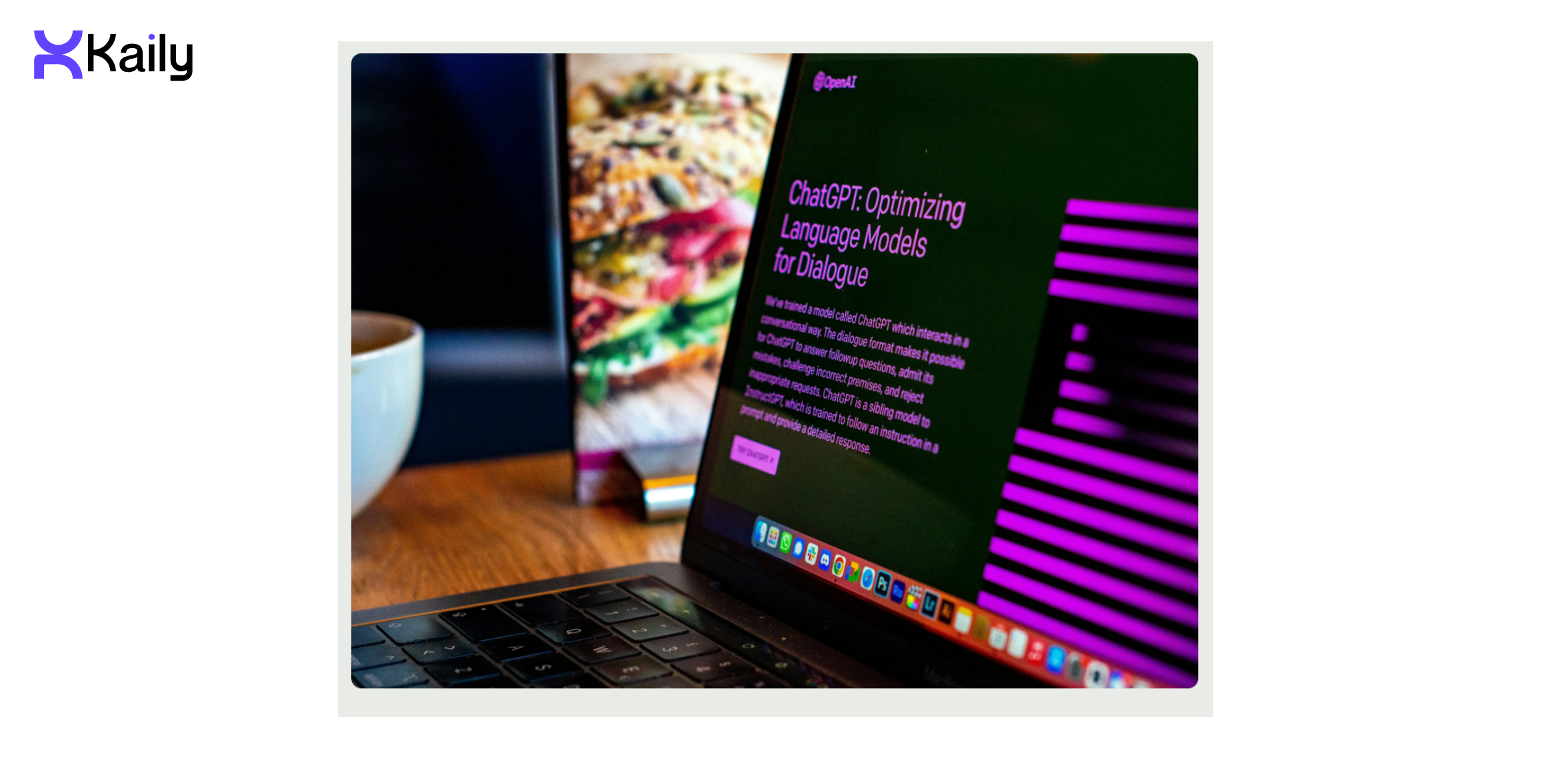


With rapid advancements in Large Language Models, you can now easily build Generative Pre-trained Transformer (GPT)-powered chatbots. These chatbots have numerous applications in the real world and can be used on various popular platforms like WhatsApp or even on a company webpage. These chatbots have the ability to generate real-time responses after considering user input and the context, making them highly useful for a wide range of business tasks.
If you are interested to learn more about GPT-powered chatbots, we can guide you. Keep reading for more information on GPT-powered chatbots, their benefits, how they work, and how to deploy them.
Understanding GPT-Powered Chatbots
A GPT chatbot can be described as a conversational agent that uses a GPT model to interact with users. These tools are powered by AI and are capable of providing quick and real-time responses with high accuracy.
- GPT-powered chatbots have high performance levels, making them ideal for several complicated business tasks.
- Some of the popular tasks that GPT-powered chatbots support include customer service, lead generation, and internal workflow automation.
How GPT Chatbots Differ from Traditional Bots?
Traditional chatbots are rule-based and depend on a pre-programmed script. Compared to this, GPT chatbots use artificial intelligence and create human-like responses. Take a look at the table below for more information on the differences between traditional and GPT chatbots.
A few significant differences are elaborated below:
- Simple And High-Volume FAQs
Rule-based chatbots are suited for simple, high-volume FAQs. The answer is that such cases may be predictable and easy to script. These bots are quick and affordable, but not suited for multi-intent queries.
- Contextual Support
GPT-powered chatbots are necessary for handling complex situations such as multi-intent queries, contextual support, or sales conversations. The advantage of these bots comes from their natural language processing ability, where they can understand context and also make improvements in response based on the user's intention.
- Affordability and ROI
The rule-based chatbots offer lower development and maintenance costs and are more reliable. These bots are easy to deploy and, as a result, offer high ROI. Coming to GPT-powered chatbots, even though these bots require a high initial investment, they offer greater flexibility and personalization. The ROI is also substantial due to the increased customer engagement and reduced costs.
Why Businesses Are Adopting GPT-Powered Chatbots?
Here are the top reasons why businesses are adopting GPT-powered chatbots.
- Superior Customer Experience
GPT-powered chatbots are capable of improving the quality of interaction with customers. Bots like AI assistant helps in providing personalised assistance, product recommendations, and quick resolution of complaints.
- Operational Efficiency & Cost Savings
Chatbots can reduce the expenses on staffing and other operational expenses. At the same time, these bots can also optimise the processes that previously needed human interaction.
- Revenue Impact (Sales & Marketing)
With the help of GPT chatbots, companies can improve their sales and marketing efforts, leading to increased revenue. There are many tasks that are supported by the bots, which include cross-selling, asking qualification questions, and even connecting the customers with the correct sales agents.
- Data & Continuous Improvement
Chatbots can collect data from the customer, which is usually used by the marketing team. By capturing information, the company can implement continuous improvement in its processes and also use the right strategy.
- Competitive Advantage
By using GPT-powered chatbots, companies can establish a competitive advantage since businesses can differentiate through better operational efficiency. This is possible through innovative customer service and superior operations.
Real-World GPT Chatbot Use Cases
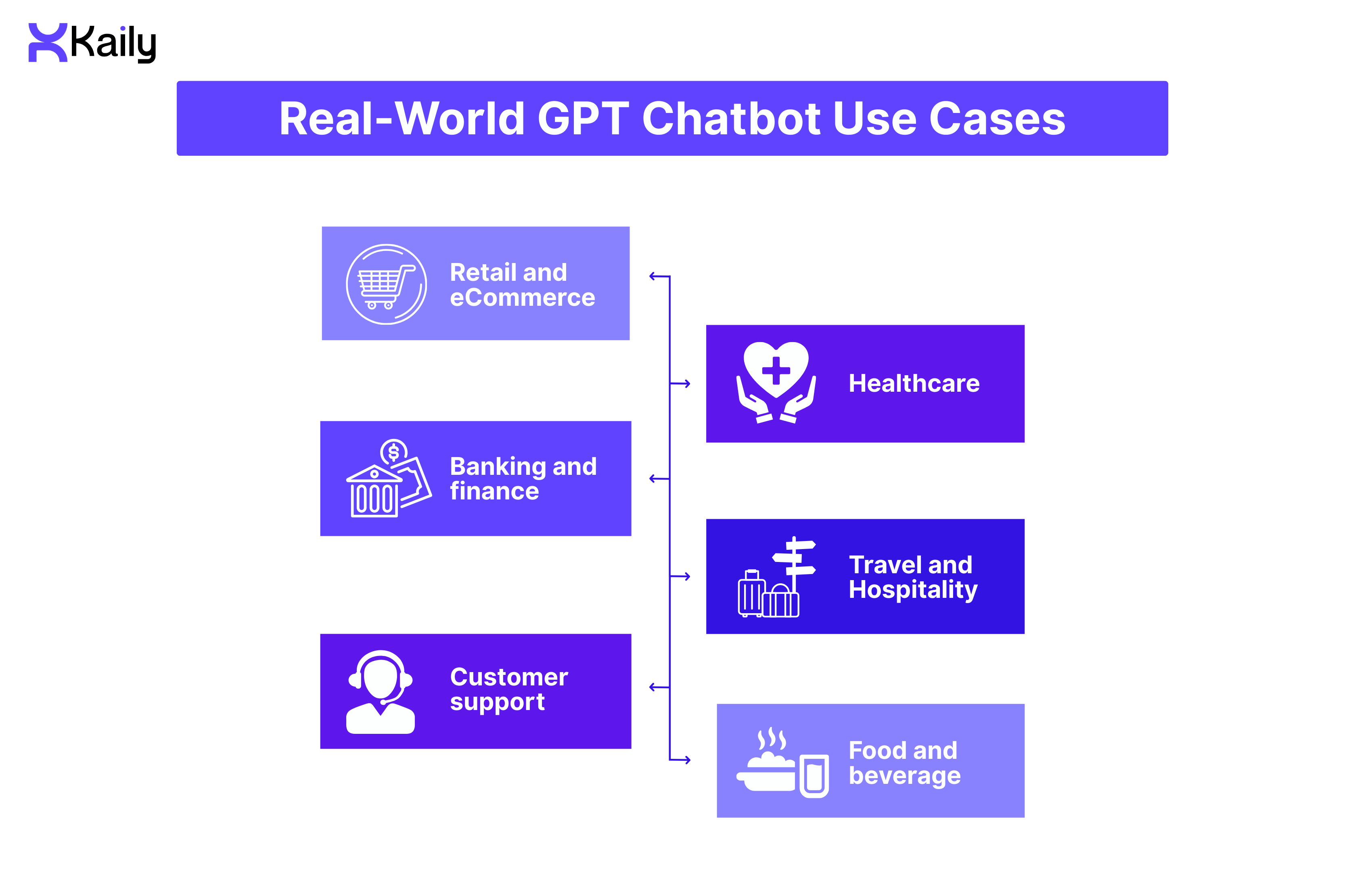
GPT chatbot has numerous applications in the real world, which allow businesses to experience many benefits. Take a look at the top business use cases.
- Retail and eCommerce
The virtual shopping assistant is popularly used to support virtual shopping. It takes into account previous purchases and analyses user preferences. Along with this, natural language processing can help to make personalised recommendations.
Examples
- Walmart’s chatbot helps to negotiate costs with suppliers.
- Zipify Agent Assist streamlines customer support operations.
- Walmart’s chatbot helps to negotiate costs with suppliers.
- Healthcare
The healthcare sector can use chatbots for assessing symptoms and also to arrive at a preliminary diagnosis. It can cross-check symptoms and also provide a knowledge base.
Examples
- Ada, a popular AI-based symptom checker.
- Florence Chatbot that creates reminders and works as a personal health assistant.
- Ada, a popular AI-based symptom checker.
- Banking And Finance
The banking sector uses GPT-powered chatbots for financial management and to provide real-time support, such as checking balances.
Examples
- Fargo, an intelligent assistant handling client interactions.
- OCBC GPT assists in ensuring data privacy.
- Fargo, an intelligent assistant handling client interactions.
- Travel And Hospitality
Chatbots can help in flight booking, check-in, and various other tasks, such as real-time customer support.
Examples
- Oyo’s Watsapp chatbot supports hotel searches.
- Equinox hotel’s chatbot “Omar” helps by supporting FAQs.
- Oyo’s Watsapp chatbot supports hotel searches.
- Customer Support
GPT-powered chatbots can provide travel support and also help in replying to customers through voice and text.
Example
- Hubspot’s chatbot offers training resources and proactive advice through the website.
- Lulemon’s virtual assistant schedules appointments and supports personalized shopping.
- Hubspot’s chatbot offers training resources and proactive advice through the website.
- Food And Beverage
An AI chatbot can simplify the order process and help to track deliveries. It works on different platforms and is helpful to increase customer engagement.
Example
- Domino’s Pizza chatbot supports ordering at scale.
- Pizza Hut uses chatbot to connect to mobile-first customers.
- Domino’s Pizza chatbot supports ordering at scale.
How GPT-powered chatbots work?
GPT models use fine-tuning and Retrieval-Augmented Generation (RAG) to address the limitations in using general data. With fine-tuning, you can retrain the model based on the data used in the industry. RAG will help to connect the chatbot and the external sources, like websites or documents.
Here are details on how GPT-powered chatbots work.
- Tokenization
The first step in operating the GPT-powered chatbot is to upload your business data. After uploading the data, it is broken into tokens and then mapped with the vectors. As the next step, the text is further broken down through a process called tokenisation.
- Vectors
Each token is then mapped to a vector. So, when a user sends a question, the bot tokenises and converts it into a vector. The base prompt will control the way responses are controlled. Thus, matching content is generated with fewer hallucinations.
- Retrieval-Augmented Generation (RAG)
Retrieval-Augmented Generation works to optimize the output of large language model to make it reference to an authoritative knowledge base. This way, the capabilities of LLMs are extended to an organization’s internal knowledge base without any type of retraining.
How To Build And Deploy A GPT-Powered Chatbot With Kaily
The process of building and deploying a GPT-powered chatbot with Kaily does not involve coding and is possible through configuration in the Kaily platform. Keep reading for step-by-step instructions.
- Sign up and navigate to the Kaily website. Use your email address or Google ID to create a free account.
- Configure the chatbot settings and customise the chatbot’s appearance so that it is aligned with the brand.
- Train the chatbot with the necessary information.
- Use the testing tools for evaluating the chatbot's performance.
- Navigate to the Deploy section in the Kaily dashboard.
- Generate the embeddable code.
- Deploy the chatbot to channels like WhatsApp.
- Monitor the analytics for insights into the bot's performance.
Risks And Limitations In Building And Deploying GPT-Powered Chatbots
While deploying GPT-powered chatbots, there are several risks you must be aware of. Take a look at the important ones.
- Leakage Of Data
This risk happens when employees input sensitive information into the prompts. This data may be used to train future models and thereby creates a possibility of data leakage.
- Prompt Injection
Prompt injection can happen through malicious prompts that can trick GPT into revealing sensitive information. This can even lead to generating harmful content.
- Intellectual Property Risks
Intellectual property may be exposed during employee interactions with GPT. This can make information accessible to competitors if they are also using the same service.
- Compliance Violations
Organisations may input sensitive data such as personally identifiable information into the GPT. This may lead to data compliance violations and loss of trust.
- Hallucinations or Harmful Outputs
The inaccurate information that may be generated through GPT is known as hallucinations. Such information can also cause wrong business decisions.
Mitigation Strategies For Building And Deploying GPT-Powered Chatbots
You must implement the mitigation strategies below to address the risks in deploying GPT-powered chatbots.
- Develop Clear Policies For Usage
There should be clear policies that specify the acceptable and prohibited use of the chatbots in an organization. These policies must address both personal and business accounts.
- Implement Security Training
Provide training programmes for educating employees about the risks and safe usage of chatbots. Role-specific training can also be provided to meet the needs of various departments.
- Deploy Technical Controls
Implement technical controls to protect sensitive data. Enterprise versions of AI tools may provide advanced security and alert security teams.
- Create Pre-Approved Prompt Templates
Such templates can guide users to provide queries without including any kind of sensitive information. This will allow users to maintain security without issues.
- Establish Review Procedures
Mandatory review procedures have to be established for chatbots before using them for crucial applications. This will help to develop guidelines for verifying information.
Best Practices:
- There should be clear policies in place for usage. Employees need to have regular training.
- Maintain data governance.
- Data loss must be prevented using technical controls.
- Review and update the security protocols regularly.
- Use a development platform with native support.
- Ensure that there are the necessary resources to support its performance.
- Optimise its performance by tuning the parameters according to the needs of the chatbot.
- Update the chatbot regularly so that it remains useful.
Platform Evaluation Checklist: Selecting The Right GPT Chatbot Tool
Here is the platform evaluation checklist to follow for selecting the right GPT chatbot tool.
- Is it easy to use and intuitive to learn?
- What is the time necessary to deploy?
- What is the pricing structure? Is it affordable?
- What are the integration capabilities?
- Is it scalable and customizable?
- Is the data protection mechanism safe and secure?
- Is there good technical support?
- Does it have good customer reviews?
Measuring Chatbot ROI: KPIs, Calculations & Benchmarks
Here are the core KPIs to measure the chatbot ROI:
ROI Calculation Example:
If the monthly conversations are 10,000, and those chatbot has resolved are 5000 chats with a deflection rate of 50%, the cost per human interaction is $10, and the cost per chatbot interaction is $0.75, the savings per month will be $46,250. Then the annual ROI will come to $555,000.









.png)


