




Have you noticed how chatbots have upgraded? From being able to answer basic questions, they are now holding meaningful and context-aware conversations.
The shift is driven by open source AI chat solutions that encourage innovation and creativity. The publicly available open access to code has empowered businesses to develop systems that are specific to them.
This is coupled with complete data privacy and all other essential features. If you are also looking to build an AI chat bot free for your company or personal needs, the article offers some suggestions. Read on to know.
Understanding Open Source AI Chat
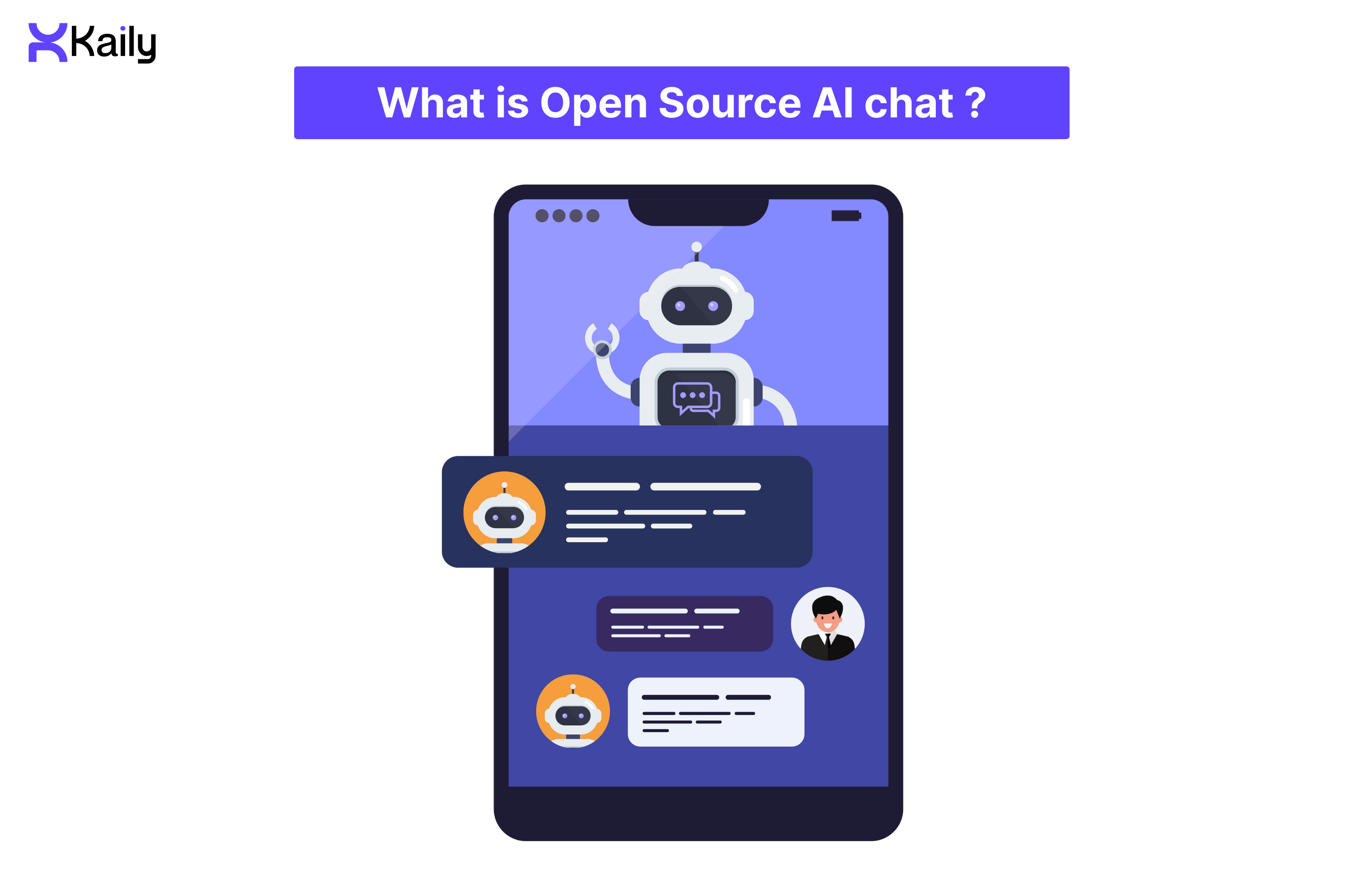
Open source AI chat refers to conversational AI systems or chatbots with publicly available code, models, and training data. These chatbots are the messaging systems that replicate human conversation by understanding intent and context. The free availability of the original base architecture allows ease of access and modification to develop high-quality software.
The property enhances efficiency, exhibits a high level of transparency and control through shared contributions. Further, it supports innovation among the developer community. The open source assistants are not ‘one-size-fits-all’ and hence are of multiple types. The different types include lightweight, generative, hybrid, retrieval-based, and task-oriented bots.
Characteristics Of Open Source AI Chat
The open source AI chat comprises foundation models, orchestration and data layer, interface, and deployment. The AI chat solution exhibits the following properties:
- Transparency: The open access to source code makes it easy to understand how the chatbot works. It enables auditing, debugging, and optimizing for building creative and innovative chat solutions.
- Control and customization: It allows fine-tuning of models using your own data, compliance requirements, and domain-specific logic.
- Cost-effective: The free availability helps avoid vendor lock-in and licensing fees. It also supports techniques like quantization and GPU sharing that reduce inference and infrastructure costs.
- Data governance and privacy: Sensitive data stays within your own environment, which is critical for regulated industries like healthcare and finance.
- Community-driven development: Continuous improvements, bug fixes, and new features are contributed by a global developer community.
- Self-hosting capability: It can be deployed on private servers or cloud infrastructure for greater control and security.
- Flexible integration: It easily integrates with existing systems, tools, and services through customizable logic and APIs.
Top Open Source AI Chat Solutions
Some of the widely known and quality open source AI chat solutions are as follows:
Now, let’s explore them in detail:
1. Rasa
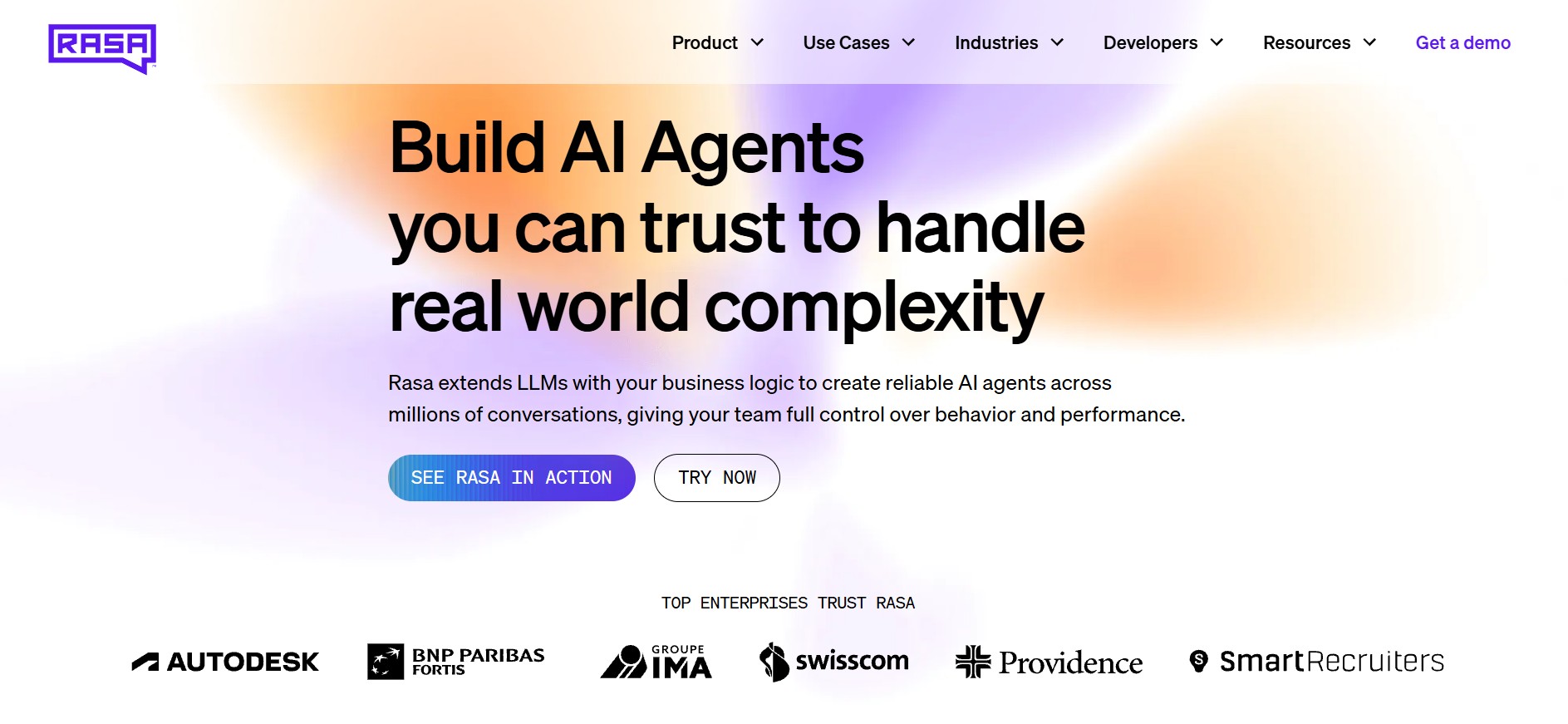
It is the leading open source framework that offers advanced Natural Language Understanding (NLU) and dialogue management capabilities. Supported to build the advanced conversational AI assistants, it is built in Python. This makes it suitable for complex, context-aware, and multi-turn conversations.
Rasa follows a story-driven approach, which means it trains the bot using conversation scenarios or stories that represent real-user interactions. Thus, it can be trained on large and high-quality datasets, such as customer service chat logs. Rasa runs on-premises by default, giving organizations full control over their data and infrastructure. This makes it a preferred choice for industries with strict privacy, compliance, and data governance requirements.
- Main Features:
The key features of Rasa include its support for text conversations across mobile, web, and messaging apps and voice-based interaction with built-in turn-taking, timeouts, and latency control.
2. Botpress
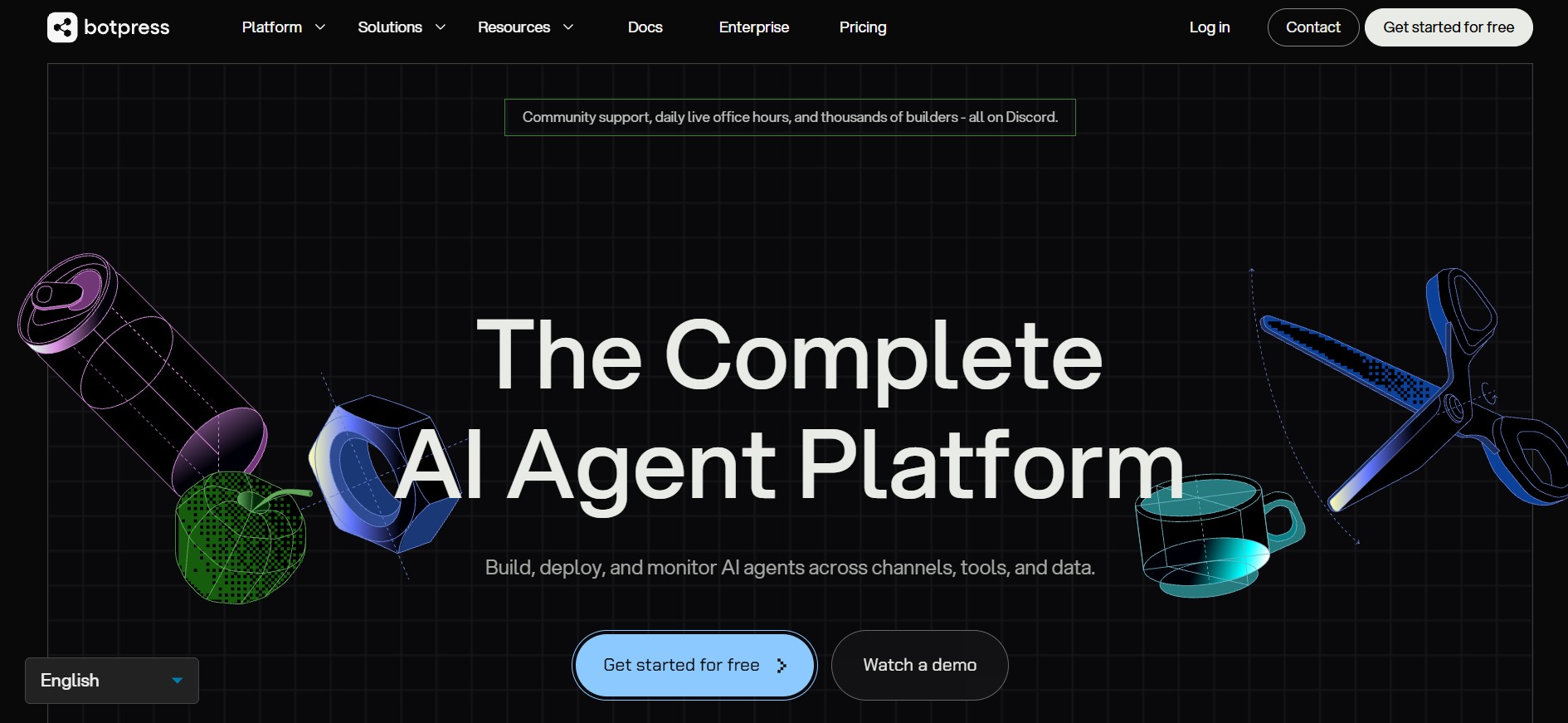
Botpress is an open source conversational AI platform designed to bridge the gap between developers and non-technical users. Built with TypeScript, it combines a visual conversation builder with a built-in Natural Language Understanding (NLU) engine. The result is faster, more accessible, and highly customizable chatbot development.
Botpress uses a visual flow editor that allows teams to design conversation logic through a drag-and-drop interface. This assists in mapping user journeys, testing conversation paths in real time, and refining responses without deep coding knowledge. Further, developers can also extend functionality using JavaScript, ensuring flexibility for complex use cases.
- Main Features:
Some of the key features of Botpress include support for over 50 international languages, seamless integration with APIs, intent recognition, and entity extraction. It also includes development tools such as custom actions and an analytics dashboard.
3. Hugging Face (Transformers)
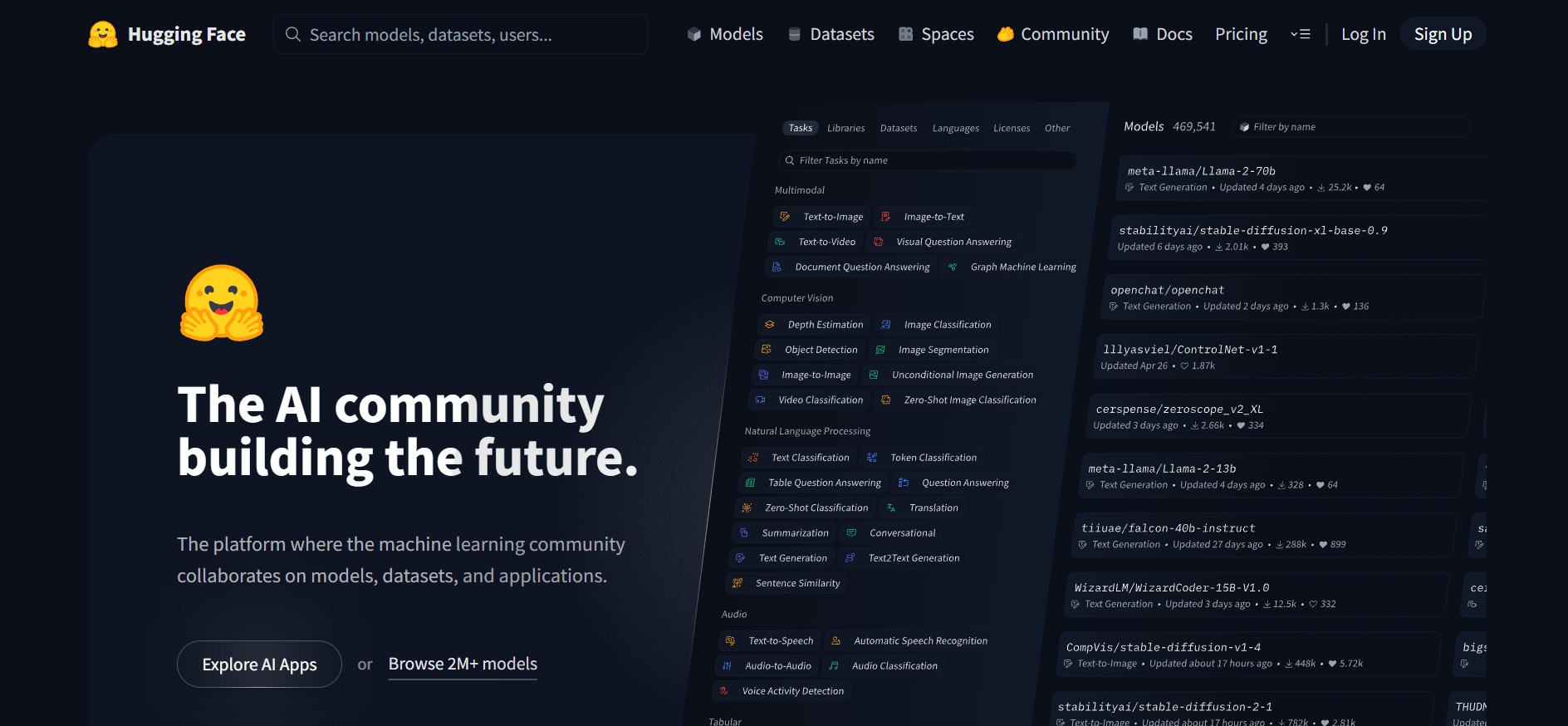
Hugging Face Transformers is a widely used open source library for building conversational AI and advanced Natural Language Processing (NLP) applications. It is part of the broader Hugging Face ecosystem, which acts as a collaborative hub for machine learning models, datasets, and AI applications. The platform enables developers and researchers to share, fine-tune, and deploy models efficiently.
The Transformers library provides thousands of pre-trained models to support conversations. Hugging Face also offers Hugging Chat, which is an open source AI chatbot powered by modern open source models like Gemma, Open Assistant, and Mistral AI. The chatbot allows users to perform web searches for more accurate and context-rich responses.
- Main Features:
The key features of the Hugging Face library include support for over 100 languages, the ability to process text classification, and perform conversational AI tasks. It also helps answer questions and summarization, making it a suitable choice for building NLP solutions.
4. Leon
Leon is an open source self-hosted personal assistant built with Node.js and Python as the core components. Keeping privacy as a priority, it is a developer-friendly personal assistant that supports scalability and control over skills. It also offers a modular structure that offers flexibility to meet the different business requirements.
Leon allows building customizable AI chat solutions for different functions like home automation, task management, and information retrieval. This AI supports voice recognition and response, and offers access to information from web data or pre-defined knowledge bases. Leon AI finds applications in developing specialized modules, personal productivity, and others. It also supports offline operations and is compatible with multiple platforms.
- Main Features:
It possesses key features like minimal privacy risks, support for multiple international languages, and the ability to add modules for easy customization.
5. ChatterBot
ChatterBot is a Python-based open source library designed to simplify chatbot development. It uses machine learning to generate responses by learning from a set of known conversations rather than relying on hard-coded rules. It makes the library suitable for building basic conversational bots with minimal setup.
ChatterBot can be trained using pre-built conversational datasets for a quick setup, or use custom dialogue data to create domain-specific chatbots. This flexibility allows the users to make it specific to different use cases, such as education, customer support, FAQs, or simple interactive applications. ChatterBot is best suited for quick implementation and basic conversational learning.
- Main Features:
The key features of Chatterbot are its easy learning ability, language independency for training, and adaptability as per the responses. It supports data import in a variety of formats and comes along with military grade encryption.
6. DeepSeek-V3.2
The latest version of DeepSeek, 3.2, is among the top open source LLMs. It is popular for reasoning and agentic tasks, and long context understanding. This version has architectural upgrades and a heavier reinforcement learning phase that enhances the thinking process of the model. There are two variants of DeepSeek, standard and speciale.
The standard version is a practical and deployment-friendly version for coding, LLM chatbot, tools, and everyday workloads. The speciale variant supports higher computing and maximal reasoning. The model is designed with efficiency-first optimization that allows faster inference while maintaining higher accuracy. The result is the ability to deliver real-time applications and large-scale deployments.
- Main Features:
The key features of the DeepSeek-V3.2 are massively high speed, less computing power (GPU hours), which makes it more affordable, and the ability to process a large amount of data.
Benefits Of Open Source AI Chat Solutions
The advantages of open source AI chat solutions are as follows:
- Allows quick testing, modifications, and experimentation with new ideas
- Helps scale independently without the necessity to rely on one provider
- Increases trust and accountability by allowing inspection and validation of AI behaviour
- Supports collaboration among developers, data teams, and business users
- Offers long-term sustainability through continued updates and support over time
- Encourages internal AI skill development, thus reducing reliance on external vendors
Comparison Between Open Source And SaaS Chatbots
The availability of both open source and SaaS chatbots is certain to confuse businesses. The best way to decide between the two is by understanding the points of difference between them:
Which Open Source Chatbot Should You Choose?
The open source AI chat solutions are a game-changer for businesses. Here are insights into which one to choose, such that it perfectly fits your needs:
- Aligns with business needs: Identify the exact business aspect that needs to be upgraded with the help of a chatbot. Understand the intention of incorporating AI chat and the relevant features that would serve the purpose. Also, decide whether you need a new AI chat solution or one that integrates with existing legacy systems.
- Uses team compatible technology: Choose the programming language of AI chat depending on the familiarity of your developers. It can be Python, Java, or any other. Also, consider the deployment platforms and development strategy when deciding.
- Suits the required chat development solution: The chatbot solutions are divided into SaaS platforms, Software Development Kits (SDKs) for on-premise, open source frameworks, and cloud-based development platforms. Choose among them the appropriate one to develop and manage a chatbot at scale.
- Integrates with existing solutions: Choose the chatbot that integrates with CRM solutions and different channels and social media platforms. It should also possess strong API support for custom integrations.
- Has multilingual capabilities: The AI chat solution must support different languages while being able to adapt to dialects, languages, and cultural nuances for personal interactions.
- Exhibits data security: The AI chat solution must be highly secure to avoid compromising the data. Hence, it should follow the latest standards and regulations, offer user privacy, and follow encryption protocols.
Conclusion
Open source AI chat solutions offer a strong foundation to build safe, flexible, and scalable conversational AI systems. Offering transparency, fulfilling the technical requirements, allowing integration, and supporting through cost-efficiency, the available options are multiple. From a lightweight chatbot to an advanced LLM chatbot, the solutions offer complete control over data, customization, and deployment. The active community support and continuous innovation further assist with ongoing improvements.
If you want the chatbot to be quickly incorporated into your business solution, Kaily is there for you. Loaded with features and meeting the variety of needs of different teams across the departments, it is a secure choice to proceed with. Explore the features and quality by trying booking a demo of Kaily.












.png)

