







AI chatbot pricing typically sits between $0 to $10,000+/month. The final cost, however, depends on the size of a business, the volume of messages it handles, and automation features offered. For example, entry-level AI chatbots are free to use and have low-cost stater plans (anywhere between $0–$50/month). It can handle basic customer enquires regarding a product/service with simple automation features which fits the need of small startups. The limitations of entry level AI chatbots are fixed message caps, no CRM integrations, and minimal analytics.
Next comes those AI chatbots that are designed for mid-sized businesses and costs anywhere between $30–$800/month. This is where you discover multiple, advanced AI capabilities, like omni-channel support across web, WhatsApp, and mobile, plus ecommerce platforms and CRM integrations.
The third category are enterprise-level AI chatbots staring at $1,000/month and can going up to $10,000 for custom deployments. Essentially, they are solution-driven options designed for companies handling thousands of conversations daily and require multi-language support, deep system integrations with dedicated SLAs and SOC 2/ISO 27001 compliance.
Some businesses also require custom-built enterprise AI chatbots that costs anywhere between $75,000 to $150,000 and above. This is an one-time build cost through to support multiple integrations and complex automations. As a smart AI chatbot Kaily hits the sweet spot for growing mid-sized businesses and enterprises with seamless AI agent workflows, a built-in helpdesk, and omnichannel deployment minus hefty price tag.
Quick Pricing Overview - How Much Does an AI Chatbot Cost?
Firstly, the cost of AI chatbots depends on the features they come with and scalability. Popular AI chatbot pricing costs can come under:
Typical Monthly SaaS Pricing Ranges
- You can find many SaaS-based or hosted “plug-and-play” AI chatbots that offer free tiers or low-cost plans of up to USD 20 per month for basic use. These chatbots are ideal for answering basic FAQs or conducting small-scale experimentation.
- SMBs often require more than basic features. They often seek chatbots that can offer more capacity, support more integrations and handle moderate chat volume. Notably, such chatbots could cost you around USD30–150 per month.
- Chatbots with more features, like AI capabilities and CRM integrations, come with subscription plans that could range from hundreds to thousands per month.
One-Time Build and Implementation Costs
- If you select a custom build instead of SaaS or pick a rule-based or much simpler chatbot, you could pay around USD5,000-15,000.
- Sophisticated AI-backed chatbots with Natural Language Processing capabilities, support for integrations and custom logic could typically cost you USD12,000-85,000. The actual price could depend on their scope for scalability and features.
- Enterprise-grade custom bots that allow heavy integrations, support compliance and help scale may come at a six-figure range.
AI Chatbot Cost by Business Size and Complexity
- Free and Entry-Level ($0-$50/month) - Free or low-cost chatbots suit small websites with low traffic. They handle simple FAQs but come with message caps, limited integrations, and single-channel support.
- Mid-Market ($100-$800/month) - This tier offers an ideal blend of functionality and affordability. Companies scaling operations use these for high-volume chat, CRM integration, and ecommerce platforms.
- Enterprise ($1,000-$10,000+/month) - Enterprise plans include multi-channel integrations, strict data security, compliance (SOC 2, ISO 27001), and multi-language support. Custom builds for high complexity can start around $50,000 or more.
When Free Chatbots Are Enough - and When They Are Not
A free or low-cost chatbot can prove enough for you in these cases -
- Your business handles low chat volume or deals with FAQ-style queries not that frequently.
- You run a small website that records minimal traffic, or you are in an early experimentation stage.
- Your operations don't require deep integrations, SLA, advanced level of automation, or support for multi-channels like web chat, social media, or WhatsApp.
However, once you scale your operations and find yourself in need of reliable integrations, third-party tools, multi-channel support, ecommerce platforms, CRM systems, or round-the-clock customer support, typically, premium plans with custom-built solutions offer such advanced features and support. So, to answer, "How much does a chatbot cost per month?”, business-ready plans with limited features could be available for free, whereas advanced features could cost tens or hundreds per month.
How AI Chatbot Pricing Models Work
Which Pricing Model Is Best for You?
Usually, the scale of operations and budget are the primary deciding factors in this case. However, if you are someone who likes to factor in every aspect, consider these aspects to select the most suitable pricing model.
A flat subscription plan would be ideal for you if you have a more or less steady and predictable chat volume throughout the year.
But a hybrid model or use-based pricing would be more cost-efficient if you are unsure of query volume or deal with spikes during peak season or popular campaigns and promotions.
If you are a startup owner or a small team that wants to experiment with chatbots and automation, a free or low-cost subscription plan may initially seem enough. However, as you scale your operations or your volume of queries grows, switching to a hybrid or use-based plan would be more effective.
However, enterprises with a wide domestic and global clientele may be suited for subscription, use-based, or enterprise contract-level plans. These pricing models account for a large user base, support multiple channels and tool integrations.
Hence, you can say that due to complexity, compliance needs, support for integration and scalability, enterprise chatbot solutions are more expensive than SMB tools.
Build vs Buy: Custom Development vs Off-the-Shelf Chatbots
One-Time Development Costs for Custom Chatbots
A basic custom rule-based chatbot could cost you anywhere between USD5,000 and USD15,000 or more. But if you seek an advanced AI agent that includes AI enhancements, natural language processing, custom logic and supports integrations, then be prepared to shell out USD 20,000 to USD 80,000 or higher.
Unlike these, the one-time chatbot development cost for custom enterprise-level bots is quite expensive. They could cost you around USD75,000 and USD 150,000 or more, if your project requires specialized functions or extensive customizations.
Ongoing Maintenance and Improvement Costs
Custom chatbots need regular maintenance, such as retraining NLP models, debugging, updates, host management, data storage, or API fees. Now, basic chatbot maintenance costs can be around USD 1,000 to USD 5,000 in a year. Meanwhile, the maintenance cost for systems supported by NLP could even go higher depending on the frequency of data updates or retraining required in a year.
When Buying SaaS Is More Cost-Effective?
If you need a chatbot for just standard requirements, such as answering FAQs or experimenting with basic automation, they can consider SaaS. A trusted SaaS provider may offer you lower costs and quicker deployment. However, that would depend on your needs and desired features.
Notably, picking SaaS means avoiding upfront build cost and reducing maintenance charges. At the same time, the burden of ensuring updates are installed and compliance is met falls upon the vendor.
But, opting for custom builds would be more suitable for you if you seek niche integrations, control over proprietary logic, data compliance, or brand tone. These customizations are where off-the-shelf tools fall short. So, to ensure competitive differentiation, explore custom builds and custom chatbot costs.
Decision Checklist: Should You Build or Buy?
Build if:
- You need full control over the system and customization
- You need integration with third-party or internal systems
- You must meet strict compliance standards
- You have large-scale growth objectives
- You have the necessary budget and technical support
Buy if:
- You want to launch quickly without extensive customization
- You need to lower upfront costs
- You don't have in-house technical resources
Note that buying a chatbot will cost less initially but may limit customization.
Hidden Costs Most Teams Underestimate
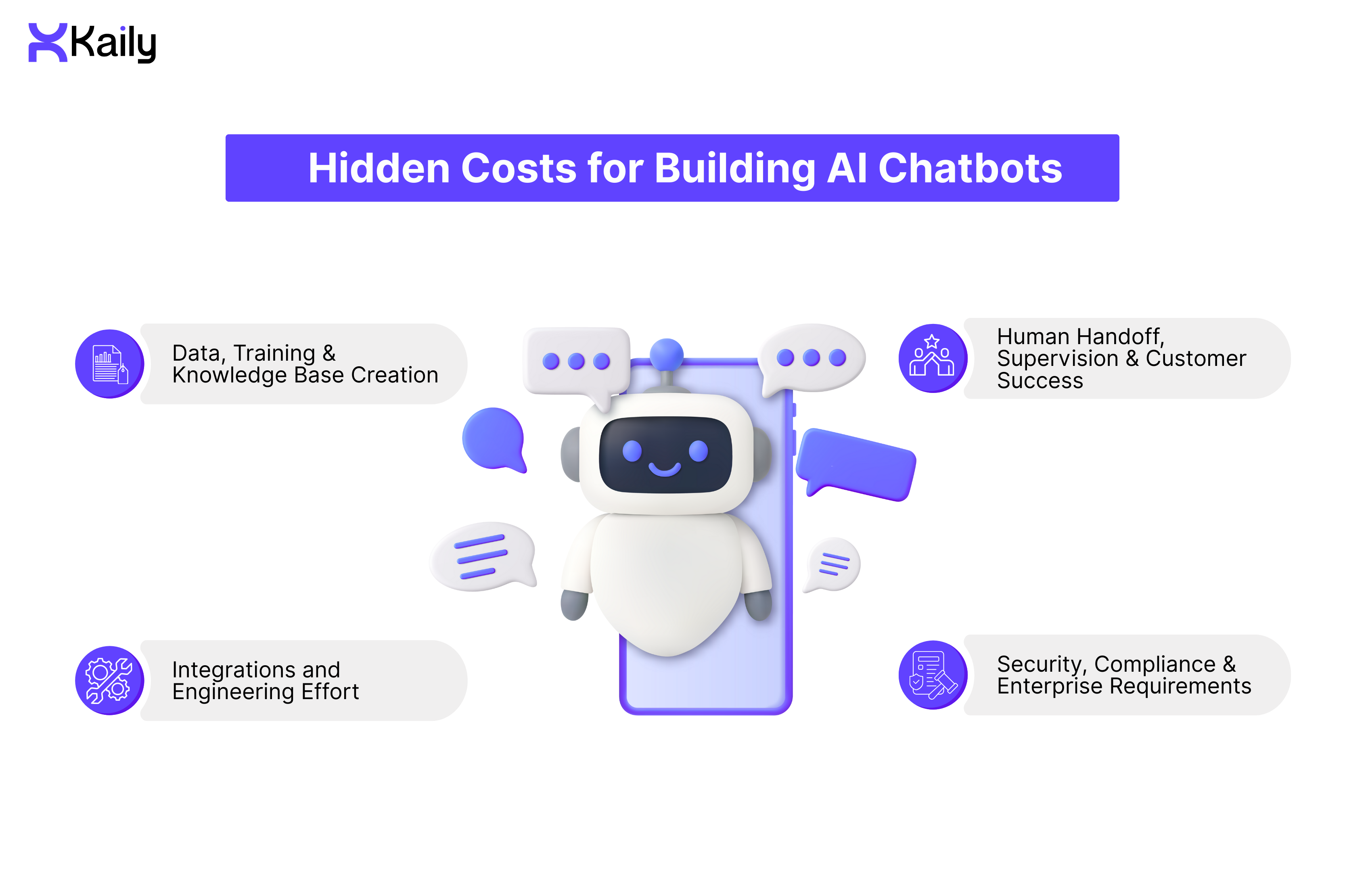
- Data, Training and Knowledge Base Creation - Many businesses ignore the cost and labour that goes into preparing FAQs, knowledge base articles, training data, or conversational flow. Meanwhile, for AI chatbot agents, you would also need to label data, refine responses and build training databases. These efforts involve both man-hours and opportunity costs that you need to account for and must not ignore.
- Integrations and Engineering Effort - You would need engineering resources to connect AI chatbots to CRM systems, ecommerce platforms, customer helpdesks, payment systems, or even internal tools. But the problem is that each integration will add to your system complexity and demand frequent testing. So, you may end up paying hosting fees or API costs. As a business owner, you must factor these in beforehand.
- Human Handoff, Supervision and Customer Success - AI cannot replace human agents when it comes to queries that exceed bot capacity or require human empathy and judgment. So, you must have a team of human experts ready to take over or supervise. Now, training human staff to monitor chatbot agents and their performance and at the same time focusing on quality output, will add to your cost.
- Security, Compliance and Enterprise Requirements - Expect to see a surge in chatbot development costs, as enterprise-level bots rely on data encryption, security audits and compliance to perform well and help you meet industry standards. If you operate in regulated industries such as healthcare or finance, you may expect compliance to be a major increase in cost and deployment time.
How to Calculate Chatbot ROI?
To compute the ROI from your AI chatbot agent, note down these indicators:
- Deflected support tickets, which show a reduction in human support loads
- Round-the-clock availability beyond business hours
- Faster response times and quality sales conversion
- Lower operational costs
Lastly, compare them with the total cost of ownership, which should include your subscription cost, maintenance, training, integration, cost of human supervision and compliance charges.
Notably, for some industries, the conversion rates can be as much as 70%. So, the ROI for those industries would be more than what others might experience.
Simple Cost Estimation Formulas and Scenarios
Monthly cost for subscription model = Base subscription fee + (average conversations per month × per-conversation rate)
Total cost for custom build) = One-time build cost + (monthly cost of hosting and maintenance × 12)
Example of Chatbot ROI Calculator:
- A small ecommerce store that deals with around 500 customer chats each month may pay hundreds of USD each month for a chatbot subscription plan. Their ROI could be marked by lowering manual support and faster replies.
- As for mid-sized businesses that deal with around 5,000 monthly chats, they may be more comfortable with a hybrid or base plan. In most cases, such plans cost a few thousand USD per month. Their ROI is marked by automation that lowers human workload.
- Enterprises that receive a large volume of chats and have multiple system integrations and channels seek custom builds that often cost thousands of USD each month. Such plans offer ROI as labour saving, improved customer support and flexible scaling.
Real-World Scenario: Mid-Size SaaS Companies
- Scenario 1: A B2B Project Management Platform that handles 3,200 chats a month.
A mid-sized project management SaaS company used to spend around USD 4,500 a month on two part-time customer support human agents. The part-timers used to handle repetitive queries about product features, billing and system integrations. The company decided to implement a basic hybrid chatbot plan that was available at USD 280 a month, plus a USD 0.15 per conversation once businesses reached a threshold of 2,000 messages. Notably, their payback period began around 1.3 months.
So, their monthly cost would come to:
# A base subscription of USD 280
# Charge for additional conversation (3,200 - 2,000) × USD 0.15 = USD 180
# A one-time integration setup of USD 2,500
# Monthly maintenance and monitoring cost of USD 150
Total monthly recurring cost of USD 610
Meanwhile, the chatbot helped the company to:
# Deflect 68% of tier-1 queries that involved 2,176 conversations
# Reduced human agent hours by nearly 55%
# Lowered support cost from USD 4,500 to USD 2,025 a month
This helped the company achieve a net monthly savings of USD 1,865 and an ROI of 366%.
- Scenario 2: A Marketing Automation SaaS Platform that handles 3,500 chats a month and experiences seasonal spikes in queries.
A marketing automation platform regularly experienced a surge in its seasonal traffic, especially during campaign launches. During those peak periods, it would record around 6,000 chats. The company realised it was overpaying during slow periods, so it upgraded to a usage-based model.
After the upgrade, their average monthly cost came to:
# A base fee of USD 120
# Charge for per conversation was around 3,500 × USD 0.20 = USD 700
# Slack and email integration charges of around USD 80 per month
# Cost of monthly optimization and retraining was around 200 a month.
It brought the company’s average monthly cost to USD 1,100 and peak monthly cost to around USD 1,520 for 6,000 conversations.
Meanwhile, the chatbot helped the company to:
# Handle 72% of pre-sales and technical questions
# Achieve flexibility during seasonal spikes and save 40% of what it was paying when using a flat high-tier plan
# Improved lead qualifications and increased demo bookings by nearly 18%
# Reduced the need for temporary customer support staff during the peak period, which helped it save USD 2,800 a month during Q4.
It helped the company save an average of USD 1,400 per month and around USD 3,100 during peak season. The company was able to achieve an annual ROI of 153% after the switch.
How Many Conversations Justify a Chatbot?
Automation starts to make sense when you see that the volume of repetitive queries is so huge that you are spending more on human efforts than on chatbot subscription or overhead collectively.
So, if your AI agent is handling hundreds or thousands of frequently asked questions every week or month, it is offering you value for your time and money.
Free Chatbots and Low-Cost Options
Features available with Free Chatbot Platforms
- It will handle frequently asked questions
- Simple chat widget
- Capped message volume
- Minimal or no integrations
Suitability: This makes free chatbot platforms suitable for websites with low traffic, small blogs and startups testing automation.
Limitations of Free Chatbot Plans
- Limited scope for branding customization
- Lack of support for multi-channels
- Limited or a lack of analytics and automation workflows
- Lack of support or Service Level Agreement
When to Upgrade from Free to Paid?
As your business scales, you will see that free AI chatbots for business are hitting their usage caps quicker than usual, and the features that are available are often inadequate. This is a sign to upgrade. Additionally, consider switching to a paid plan when you are -
- Exceeding message limits almost every day.
- Planning to integrate CRM and ecommerce platforms, need multiple channels, analytics and could use continuous support.
- Seeking conversational AI, relevant answers and ticket routing options for complex queries.
While many platforms offer freemium tiers, can small businesses rely on free chatbot plans long-term? As long as businesses feel comfortable and their requirements are minimal, free chatbots could be enough. As for those who are still on the quest to find out if there are any free AI chatbots for businesses, they should be prepared to work around limitations that come with such options.
How to Choose the Right AI Chatbot Plan?
Compare features with your requirements and ask yourself these important questions -
- Do I handle just simple FAQ, or would I need something more advanced conversational AI with NLP?
- Am I expecting a high volume of messages or an occasional spike in traffic during peak seasons?
- Do I plan to plug it into my CRM systems, ecommerce platforms, ticketing tools or payments channels?
- Should it work across multi-channels like webchat, WhatsApp and social media for better sales conversion?
- Would I need a Service Level Agreement, strict security, compliance and total data control?
Ask Chatbot Vendors About Pricing
- Is there a limit on the monthly messages, active chats and number of user accounts?
- Are integrations part of the plan, or do I have to pay extra?
- What’s the difference between chatbot vs live chat cost?
- What kind of support and uptime can I expect?
- How will you handle data privacy and compliance?
- Do I have to bear a cost jump if conversation volume spikes suddenly?
Negotiate for a Decent Enterprise Deal
Ask them for a short trial or pilot plan with fixed pricing to test the system. It is important that you share realistic use patterns and requirements. This will help you negotiate caps so that you don't hit unexpected limits and pay overage fees. Also, set clear metrics to measure ROI and compare with the chatbot pricing for small businesses. Lastly, request a full cost breakdown to understand subscription chatbot pricing, use-based charges, integrations and chatbot maintenance costs.
Then, list down the pros and cons of plans for a thorough chatbot pricing comparison to understand whether building or buying ready-to-use chatbot platforms would be suitable.
If you have more questions, contact team Kaily for a quick consultation.
Book a Demo Now!









.png)

