




Voice AI chatbots are no longer just about convenience. In 2026, they are becoming one of the most powerful ways businesses interact with customers.
People prefer to talk rather than type or read. Whether they’re checking an order status, booking a hotel room, or confirming a loan balance, they want real conversations. That shift is exactly why voice AI chatbots are moving from experimentation to core customer experience infrastructure.
In this blog, we’ll cover:
- What voice AI chatbots really are
- Why adoption is accelerating across industries
- Real outcomes and real use cases
- Where voice chat AI bots work best today
- What to look for when choosing a voice AI solution
- How platforms like Kaily’s Voice AI Chatbot fit into the bigger picture
Read on to get practical clarity, no hype.
Have A Look At Voice AI Chatbots: What Are They?
Voice AI chatbots are AI-powered systems that can hold real-time spoken conversations with users and complete tasks end-to-end.
A modern voice chat AI understands natural speech, interprets intent, and responds intelligently. This is very different from traditional IVR systems that force users to “press 1” or “press 2.”
At a basic level, a voice AI chatbot combines:
- Speech-to-text to understand what the user says
- AI reasoning to determine the next action
- Text-to-speech to respond in a natural voice
To users, the experience no longer feels like talking to a machine. It feels like speaking to a capable human assistant.
That’s why terms like:
- AI voice chatbot
- AI voice bot
- Voice bots
All refer to the same idea: AI that can listen, talk, and act.
Why Voice Chat AI Bots Matter More In 2026
Voice adoption isn’t happening in isolation. Very real operational pressures drive it.
Here’s what the data tells us.
Call Volumes Are Rising, But Budgets Are Not
Across industries, call volumes are expected to grow significantly through 2027, while support staffing budgets remain flat. Businesses simply cannot scale human agents fast enough. Voice AI chatbots absorb demand without sacrificing service quality.
Consumers Are Already Comfortable With Voice
More than 49% of U.S. adults have tried voice-assisted shopping, and adoption continues to rise. Once users get used to speaking to AI, typing starts to feel slower and unnecessary.
ROI Is No Longer Theoretical
Banks, retailers, and healthcare providers are already reporting:
- Maximum reduction in handle time for common queries
- Fewer missed payments using voice reminders
- Better recovery of abandoned carts via outbound voice calls
Voice is no longer “experimental.” It is measurable.
Voice vs Chat vs Human agents: A Practical Comparison
Voice AI is not replacing humans. It’s replacing wait times, repetition, and friction.
How Voice AI Chatbots Work Behind The Scenes
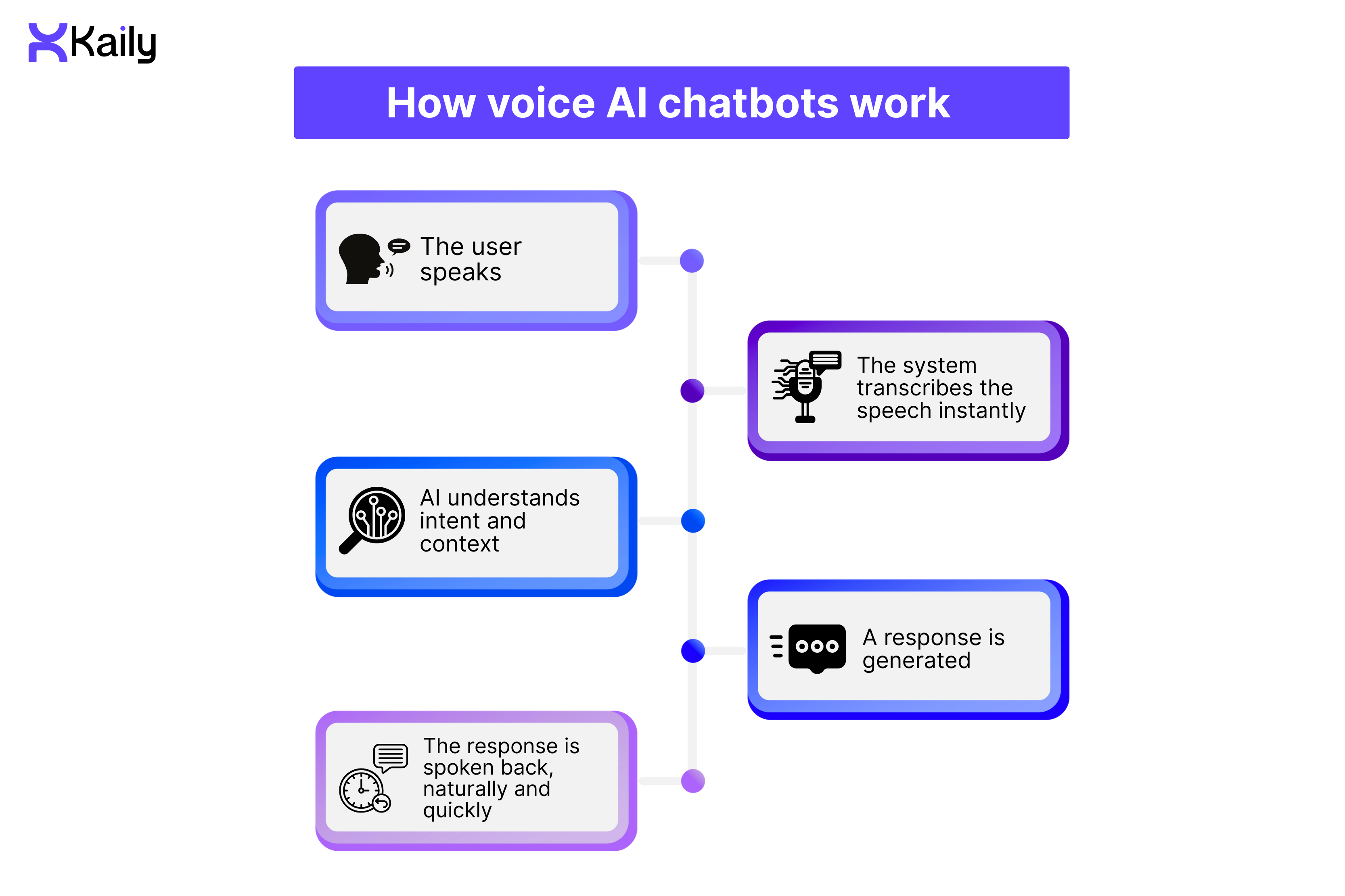
In 2026, a voice AI chatbot follows a simple conversational loop:
- The user speaks
- The system transcribes the speech instantly
- AI understands intent and context
- A response is generated
- The response is spoken back, naturally and quickly
What’s changed recently is speed and realism.
Today’s voice chat AI bots:
- Respond in under half a second
- Handle interruptions naturally
- Resume conversations without losing context
- Switch languages mid-call if needed
This is why voice interactions now feel fluid rather than robotic.
Where Voice AI Chatbots Deliver The Biggest Impact?
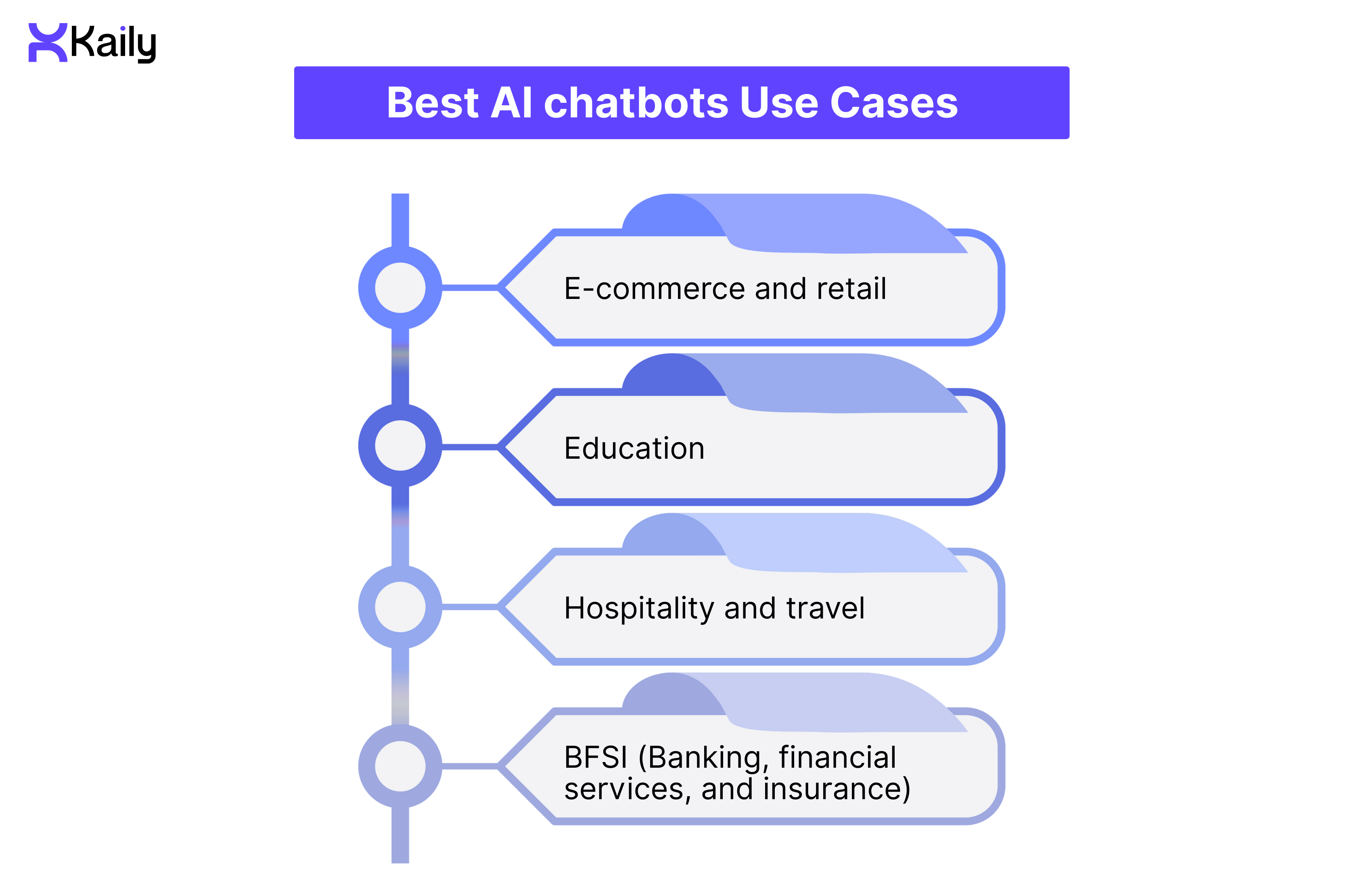
Voice doesn’t fit every use case. But where speed and volume matter, it wins decisively.
E-commerce And Retail
Retail is one of the fastest adopters of voice bots. The most common use cases include:
- Order status inquiries
- Delivery tracking
- Return and refund questions
- Abandoned cart recovery
One retailer's study shows 35% of abandoned carts were recovered using voice reminders. That’s significantly higher than email alone.
For high-volume queries like “Where is my order?”, voice AI chatbots can reduce live-agent load to a great extent.
Education
In education, voice bots really work because they reduce friction. Students and parents use voice chat with AI to:
- Check admission status
- Book counseling calls
- Confirm fee payments
- Get class schedules
Voice works especially well for non-technical users who prefer speaking over navigating portals.
Hospitality And Travel
Hospitality is inherently conversational. Hotels and travel providers use voice AI chatbots to:
- Handle booking confirmations
- Answer check-in and check-out queries
- Provide local recommendations
- Manage appointment or service requests
Voice outreach has also led to a great increase in scheduled service bookings in automotive and travel-adjacent sectors.
BFSI (Banking, Financial Services, and Insurance)
BFSI demands accuracy, speed, and compliance. Voice chat AI bots here handle:
- Balance inquiries
- EMI reminders
- Policy status checks
- Fraud alerts and confirmations
For example, in a banking pilot, a great number of calls can be fully resolved by a voice bot. The best thing about it is that the average handle time drops from minutes to just a few seconds.
Key Benefits Of Voice AI Chatbots
When implemented well, voice AI chatbots deliver great benefits. And these tend to compound over time.
24/7 Availability
Voice bots never sleep. Customers get instant responses, even during peak hours or holidays.
Faster Resolution
Finance queries save an average of 4 minutes per interaction when handled by AI voice bots.
Lower Operational Costs
Healthcare voice chat AI bots alone are projected to save $3.6 billion globally through administrative automation.
Higher Customer Satisfaction
Shorter wait times and natural conversations directly improve CSAT scores.
Common Challenges (And How Businesses Handle Them)
Voice AI works really well, but it is not magic, right? It has its share of challenges, too. The good news is that most are manageable in 2026.
Accuracy and Hallucinations
Modern voice AI chatbots now restrict answers to approved knowledge bases. This significantly reduces incorrect or fabricated responses.
Latency Issues
Users hang up if there’s more than two seconds of silence. Streaming responses and filler prompts solve this.
Compliance and Privacy
Most enterprise-grade voice chat AI bots now support GDPR, SOC-2, and industry-specific compliance requirements.
The key is choosing a platform built for real-world deployment, not demos.
What To Look For In A Voice AI Chatbot Platform
Before choosing a solution, ask these questions:
- Does it support natural interruptions?
- Can it connect to my CRM or order system?
- Does it work across phone, web, and messaging?
- How quickly can it be deployed?
- Are analytics and call insights built in?
These factors matter more than flashy demos.
Kaily’s Voice AI Chatbot: What’s Unique
Voice AI should be as easy to launch as a landing page. Most voice AI platforms are built for engineers. Kaily is built for operators, CX leaders, and growth teams.
What Makes Kaily Different
- Deploys on regular phone lines, web voice widgets, and WhatsApp
- Supports both inbound and outbound calls
- Handles interruptions naturally
- Syncs with tools like Shopify, Zendesk, and HubSpot
- Offers multilingual voice support
- Hands off seamlessly to human agents when needed
In short, it removes the technical burden that often slows voice AI adoption.
Is Voice AI Right For You?
Voice AI is a strong fit if:
- You handle high call volumes for repetitive queries
- Customers often ask for status updates or confirmations
- Wait times impact CSAT
- Your team struggles to scale support affordably
- You want automation without engineering overhead
If you checked 3 or more boxes, voice AI is likely worth testing.
Getting Started With Voice AI Chatbots In 2026
If you’re evaluating voice chat AI bots, start small and focused.
Best first use cases:
- Order or appointment status
- Balance or payment reminders
- Booking and scheduling
- High-volume FAQs
Measure:
- Containment rate
- Average handle time
- Customer satisfaction
- Revenue recovery or cost savings
Voice success compounds once the basics are right.
Final Thoughts
Right now, the most natural interface between humans and machines is an AI chatbot. Because customer expectations are rising each day and so the operational pressures increase. The tools are becoming a competitive advantage.
The businesses that win in 2026 won’t answer every call manually. They’ll use scalable voice AI to handle conversations instantly, accurately, and around the clock. See what voice AI can do for your business.
Book a live demo of Kaily’s Voice AI Chatbot and see how real conversations get resolved automatically, at scale.












.png)

