


Automated customer support, also known as customer service automation, is the use of technology, often powered by AI and machine learning, to manage routine tasks. It uses technology to resolve customer queries, answer questions, and guide customers with minimal human intervention.
Modern businesses use machine learning, workflow automation, and Natural Language Processing to provide quick and efficient support across their communication channels.
Advanced AI agents like Kaily are trained on brand knowledge and insightful data to provide users with help around the clock. Awareness of brand guidelines and customer data further allows them to boost efficiency by delivering faster responses and accurate solutions. This arrangement boosts customer engagement and satisfaction while allowing human agents to focus on the strategic part of their role.
How does customer service automation work?
In customer service, automation typically relies on intelligent agents that can understand and interpret customer queries and act on them accordingly.
Such agents process available input from live customer chat, email chains, or voice notes to respond. Access to trained models and knowledge bases further allows them to offer accurate solutions. This will enable businesses to guide users through transactions and updates, or to escalate a matter as and when needed.
Kaily platform integrates with Customer Relationship Management System and integral support platforms to connect processes across operational systems and align brand tone.
Today, most AI agents use Natural Language Processing to interact with users and resolve their queries.
Similarly, systems access real-time data and information from the company to ensure responses are relevant and natural. These systems help automate repetitive tasks, allowing human agents to focus on other essential tasks.
How to automate customer service?
The first step to customer care automation is to set clear, feasible goals and pick platforms that match the intent. For instance, advanced automation includes AI chat, data sets, knowledge bases, ticket classification, and self-service portals.
Based on your needs, your customer care automation process can benefit from mapping frequent queries and concerns. You can support your process by choosing automation platforms that can integrate across multiple channels and tools. Additionally, train your AI agents on your policies, workflow systems, and brand tone. Subsequently, test real scenarios before launching them in phases.
Remember, efficient customer service automation solutions operate in blended modes, where simple tickets are resolved quickly and complex questions are routed to human experts.
What are the benefits of customer service automation?
Automating customer support can help resolve routine queries, raising a business's CSAT by at least 20% and lowering the need for large support teams. Research shows this helps reduce customer service costs by 30%.
Beyond that, it can boost resolution speed by 90%, which is invaluable for peak cycles. In turn, it allows agents to focus more on helping customers with unique needs or strategise better.
By handling repetitive customer support tasks, automation can lower the cost per ticket significantly. It also ensures that new and existing customers can access 24/7 assistance, with no missed SLAs or drop-off in leads.
Gartner and McKinsey estimate that businesses that adopt automation for customer service see a 20% reduction in cost-to-serve and a boost in loyalty and client retention. These make a strong case for automation of customer service in today's market.
How do you know if your automated tools are working?
Set clear KPIs to measure the impact of automation. KPIs such as resolution rate, CSAT, resolution time, and deflection rate can be helpful for this.
Notably, the resolution rate will help you understand the share of queries that your CRM system resolved without human intervention. The deflection rate will also show how many tickets were self-serviced and not sent to human agents.
Meanwhile, CSAT shows customer satisfaction levels before and after automation, offering you a clear insight into the progress and impact. Similarly, the average resolution time should tell you how much time your business is saving after the automation of customer service.
While KPIs are essential for understanding performance, regular reviews and customer feedback can further help improve tone and accuracy. Both are important to improve performance and outcomes.
Examples of customer service automation
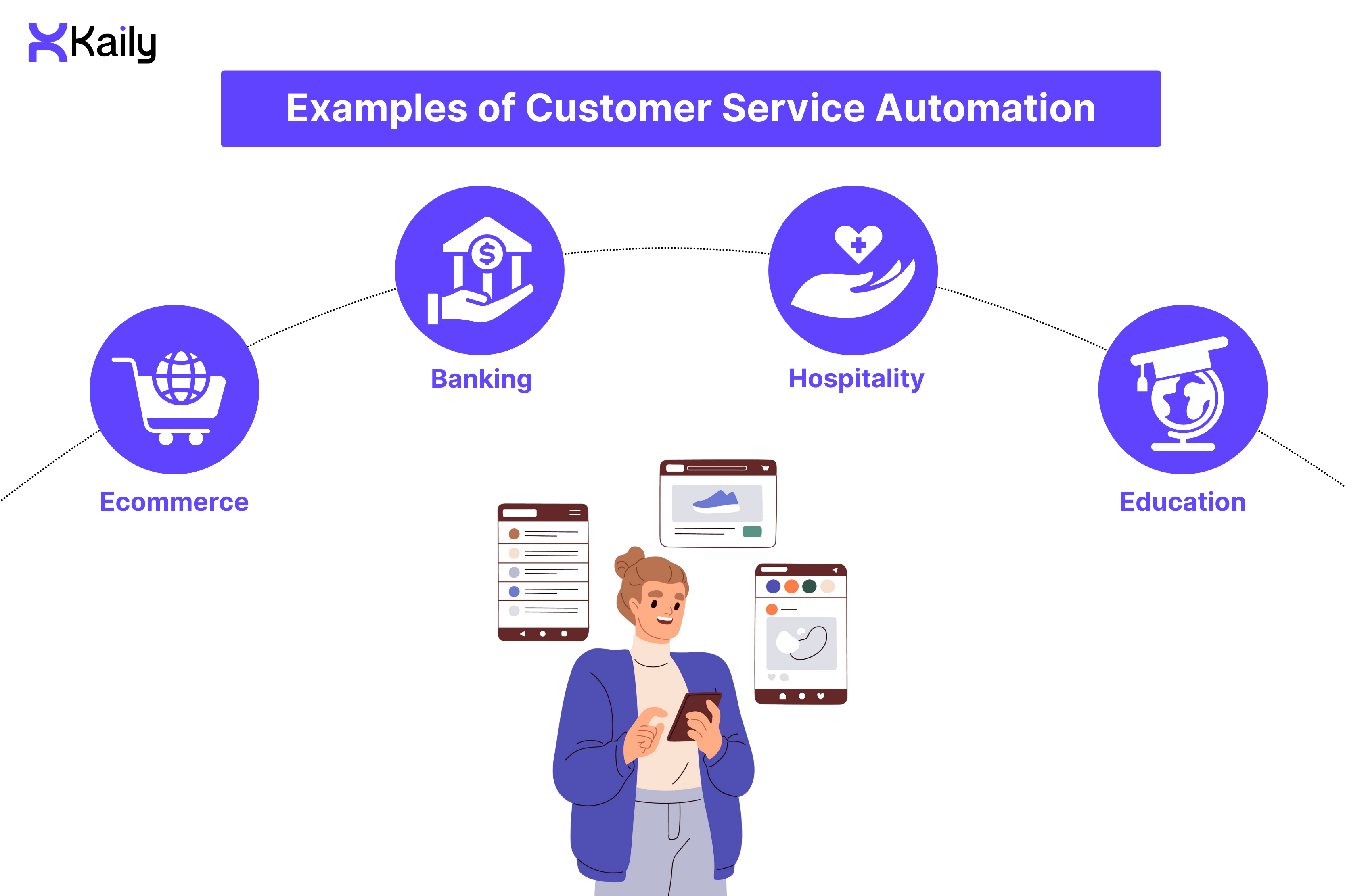
Many enterprises and startups use AI agents to scale their operations. Frequent integration is seen across sectors like:
- Ecommerce
Research by Martinez and Kumar found that 67.3% of consumers preferred AI-powered self-service options over human interaction when seeking assistance for routine tasks. This means more retail queries related to order tracking, returns, and offers are routed and solved through automation every year.
- Banking
Bank of America’s Virtual Assistant Erica sorted over 3 billion customer queries and assisted nearly 50 million users to lower wait times. Several banking apps today come with AI agents to help users access their bank accounts and financial details within minutes.
- Hospitality
Hotel chains are using AI agents to handle bookings and interact with guests online. This is lowering their response time and ensuring complete customer satisfaction. Hospitality giants, such as Marriott International, are also exploring AI-powered virtual assistants to improve their guest services.
- Education
Several Universities in the USA now deploy automated helpdesks during their peak admissions season to lower delayed requests.
This shows a growing acceptance and the scope of application for automation in customer support.
How do you get started with automated customer service?
You can begin your customer care automation journey in these steps:
- Step 1: Audit and Identify
Audit all existing support flows and sort them. Next, find the most repetitive tickets to free up your time and resources.
- Step 2: Define Relevant KPIs
Find out which KPIs are most relevant for your business and then work around them. Try to target at least 70% automation in one quarter and a CSAT boost.
- Step 3: Select an Agent
Focus on selecting an AI agent that can integrate your stack and align your brand vision with every interaction.
- Step 4: Train and Provide
Training your agent is an important step, as the success of automation and customer response depends on it. Hence, start with training your agent on real chat history, customer data, and recent case studies to ensure it offers reasonable resolutions for unique user queries.
- Step 5: Launch and Analyse
Plan a phased launch. Start with a small number of users or focused regions and repeat the process if desired. Your goal should be to gather initial feedback, understand reception, analyse data, and then improve on the gaps.
Beyond these steps, it is essential to train internal departments and staff to make the most of automation and AI agent tools.
The impact of automation on enterprise customer service
A 2024 McKinsey report found organisations using gen AI systems saw their average call resolution time drop from 125 minutes to just a few seconds. It is also helping them optimise call volume forecasting and improve accuracy by 7 percentage points. In turn, it's reducing the efforts that go into managing team capacities or their daily schedules.
Meanwhile, large enterprises combining automation of customer services with human expertise are delivering on-brand resolutions at times that demand critical judgment or empathy. For instance, the International Journal for Multidisciplinary Research (IJFMR) found that 31% of customers still prefer human agents. Hence, AI agents can not replace human support entirely and must work with each other to achieve desired results.
In this way, customer service automation is helping modern businesses to keep their customers satisfied and scale their operations. Recent findings of IJFMR suggest that 37% of companies are already using AI agents and 46% plan to automate to optimise their customer support services. This again shows that the future is centred around automation and will shape customer engagement and lead generation in the years to come.
By investing in the right AI-powered agent platform, you can adapt and optimise your customer support services. However, having the proper support is crucial during the customer service automation process to ensure smooth integration with workflow systems. That's why it is essential to talk to professionals who specialise in automation and understand customer service like the back of their hand.
Talk to team Kaily to avail the best solution for your customer relationship management needs.