








Conversational AI is changing the way businesses engage with consumers. From answering FAQs to resolving support tickets across channels, Conversational AI makes every conversation more automated, innovative, and personalised. In this article, we'll explain what Conversational AI is, how it works, its benefits, the best platforms for it, real-world examples of how it's used and how you can use it in 2025.
What is Conversational AI?
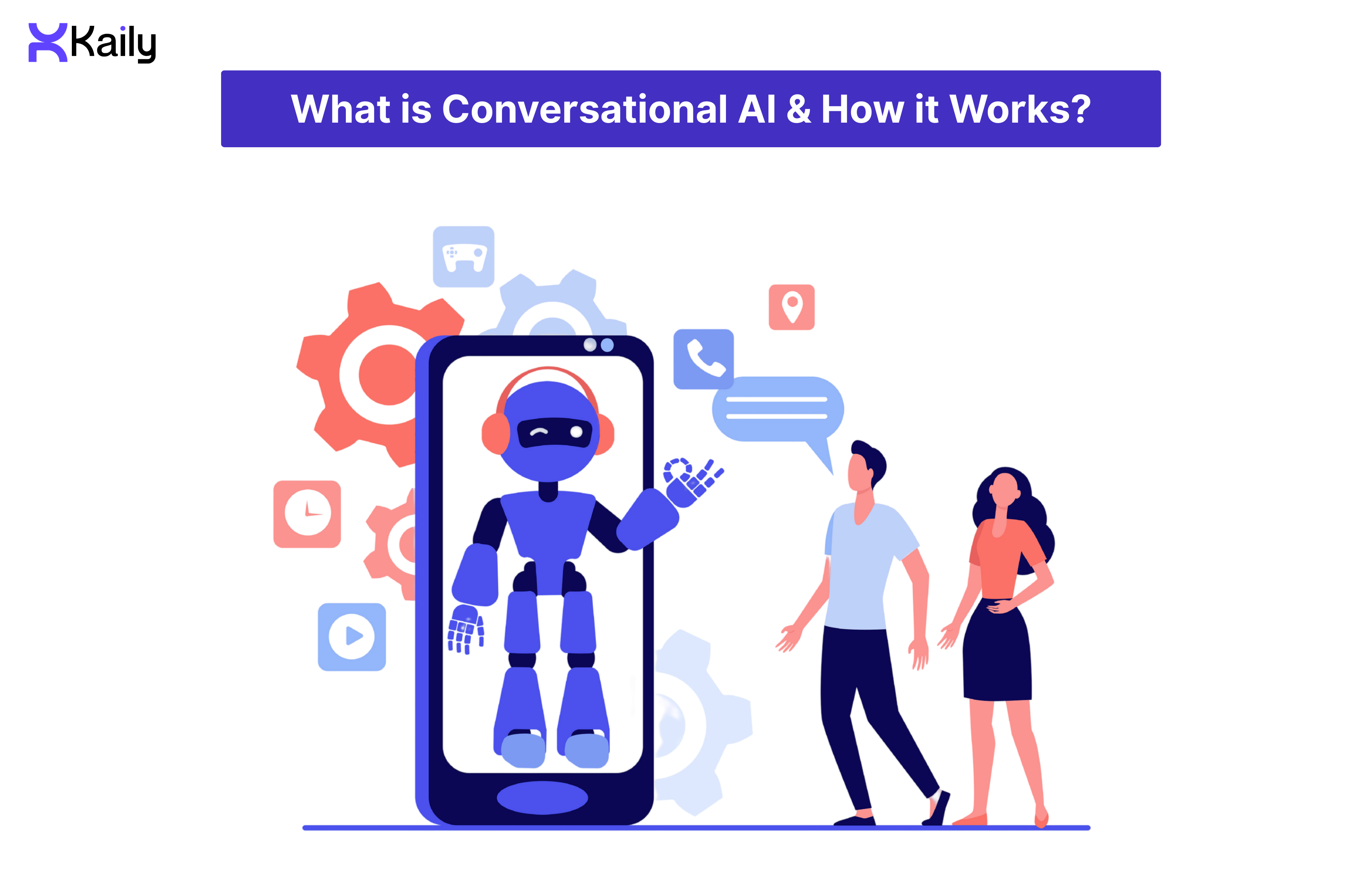
Conversational AI refers to a set of technologies that enable computers to understand and respond to questions or commands through text or voice, making conversations more natural and meaningful. It uses natural language understanding (NLU), machine learning, and large language models (LLMs) that enable computers to simulate human-like dialogue.
Conversational AI is more advanced than regular chatbots. It can understand what you mean, recall what you indicated before, hold conversations with multiple turns, get real-time data, and do tasks like update orders, check CRM records, or make appointments.
The Evolution of Conversational AI
Conversational AI has come a long way from the time of basic scripted programs. Now, it can actually get things done. This is how it changed over time:
- The 1960s: ELIZA was one of the first programs that allowed users to have a conversation. It "talked" to users using simple scripts and pattern matching. It was simple, but it showed that machines could learn to understand human language.
- 1990s: The first chatbots that businesses could use were only based on rules. They could answer simple questions, but were found to be stuck as soon as someone went off script.
- Machine Learning and Virtual Assistants in the 2010s: AI became much better thanks to Machine Learning (ML) and Natural Language Processing (NLP). Voice assistants like Siri and Alexa could understand natural language and learn from conversations, which is a big step up from fixed scripts.
- 2020s: AI agents like Kaily can do a lot more than just answer questions. They can handle complicated workflows, work with business systems like CRMs and ERPs and automate tasks across all channels.
How does Conversational AI Work?
Conversational AI works by quickly linking different technologies together to take in human input and give an innovative and relevant answer.
- Input Processing (Hearing/Reading): The system first gets the user's input, which can be text (like chat or email) or voice. If you speak into the machine, a Speech-to-Text (STT) engine converts the sound wave into written text that the machine can analyse.
- Understanding (NLP/NLU): This is when the machine figures out what a particular thing means.
- Natural Language Processing (NLP) looks at the grammar and structure of a sentence.
- Natural Language Understanding (NLU) looks at the text to figure out what the user wants to do (For example, I want to check my balance.)
- Natural Language Processing (NLP) looks at the grammar and structure of a sentence.
- Dialogue Management: It uses machine learning models and pre-defined business logic to figure out what to do next. It keeps track of the conversation, decides whether to answer a simple question, execute a complex action (like connect to a CRM), or pass the conversation on to a human agent.
- Response Generation (NLG/Generative AI): The system builds the answer after the action has been chosen. Natural Language Generation (NLG), which is often based on Generative AI (LLMs), generates an answer that sounds like a person, is grammatically correct and fits the situation.
- Output Delivery (Speaking/Writing): The user gets the final answer. For text chats, it shows up right away. For voice interactions, a Text-to-Speech (TTS) engine turns the text response back into synthesised speech.
Types of Conversational AI
Chatbots aren't the only thing that Conversational AI is meant for nowadays. It can also support a wide range of innovative and task-focused applications.
- Chatbots: They are mostly text-based tools that are often found on websites to answer basic questions and redirect support requests.
- Voice Assistants: Systems like Amazon Alexa or Google Assistant that mostly communicate through voice can perform tasks like set reminders, make calls and control smart devices.
- Virtual Agents or AI: They do more than just chat; they are integrated with back-end enterprise systems to automate end-to-end workflows. They are designed to function as a full-fledged team member and thus, can handle complicated tasks across multiple channels like chat, voice, email and WhatsApp.
- Copilots: AI tools integrated directly into an employee's workflow, like in Slack, a CRM or a coding environment. They assist individuals by getting information, writing replies or generating code, which significantly boosts productivity.
Top Benefits of Conversational AI
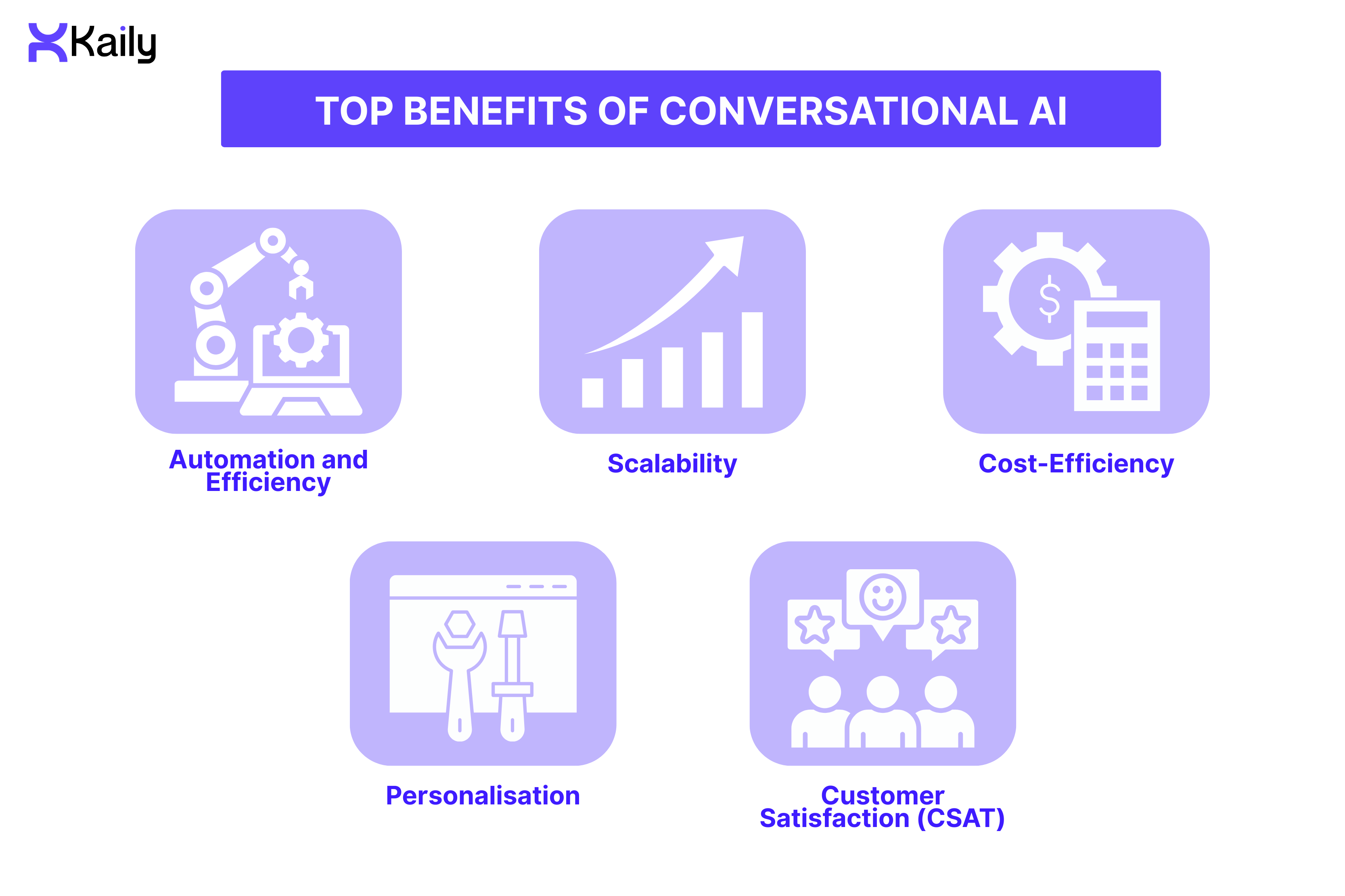
Deploying conversational AI to your business and integrating it with other systems can help everyone on your team work more effectively, which will help you scale faster and run your business more efficiently.
- Automation and Efficiency: Conversational AI agents can answer up to 80% of routine questions from customers and employees, allowing humans to focus on more difficult and high-value tasks that require empathy and critical thinking.
- Scalability: AI agents can handle an unlimited number of conversations at once, 24/7/365. This means that support can be instantly scaled during peak season.
- Cost-Efficiency: Businesses can save a lot of money on operations while still providing excellent customer service by automating routine questions and not having to hire and train new agents all the time.
- Personalisation: The AI keeps track of past interactions, purchase history, and stated preferences from CRM integrations. This lets it make hyper-personalised suggestions and solutions that make customers satisfied and boost sales.
- Customer Satisfaction (CSAT): Quick, correct and consistent answers that are available on the customer's preferred channel get rid of frustrating waiting times and significantly improve the overall customer experience.
Best Conversational AI Platforms
Businesses today need more than just a simple chatbot. They need a solution that is safe, can scale with their evolving needs and can fully integrate and automate workflows. Here is a comparison of some leading platforms.
1. Kaily
It is an advanced AI Agent platform that automates your customer support, sales and marketing processes across all key communication channels (Chat, Voice, Email and WhatsApp), all without having to write any code. It connects directly to your current business systems, such as CRMs and Slack, to handle complicated workflows from start to finish.
Pros:
- End-to-End Automation: Can handle complicated and multi-step business processes across departments, unlike simple bots that only answer questions.
- Global Language Coverage and Unified Control: You can control all of your digital and voice interactions in more than 100 languages from a straightforward platform.
Cons:
- Too Powerful for Small Needs: It's best for businesses that need automation across many channels on a large scale. One may find it over-featured if they only need a very basic FAQ chatbot for a small website.
2. Kore.ai
A powerful no-code/low-code platform for creating intelligent virtual assistants (IVAs) that handle customer service, IT and HR tasks for large businesses.
Pros:
- Very scalable: Made to handle high volumes of interactions for companies all over the world.
- Flexible AI Models: Allows businesses to use different Large Language Models (LLMs) to get the most effective results.
- Focus on Security: Offers strong security and compliance features that are very important for regulated industries like healthcare and banking.
Cons:
- Complexity: The platform has a lot of features, which can make it harder for business teams to learn how to use it.
- Cost: Large businesses usually get custom pricing, which may be too high for mid-sized or smaller organisations.
3. Google Dialogflow
Google Cloud has a strong Natural Language Understanding (NLU) service for making conversational interfaces.
Pros:
- Advanced Understanding: Has some of the most advanced technology for finding out what a user wants and what they're doing (intent and context).
- Seamlessly integrated with Google: Works perfectly with Google Cloud, including Contact Centre AI tools.
- Flexible Deployment: Great for projects that need a lot of customisation and control over the code and APIs.
Cons:
- Heavy-coded: To build advanced features like updating a CRM or checking order status requires you to be a good coder and have access to developer resources.
- Scaling that comes at a heavy cost: When there is a high volume of voice traffic or requests, usage-based pricing can quickly get expensive.
4. IBM WatsonX Assistant
A powerful AI solution that uses advanced language models to create secure, compliant, and highly governed assistants, especially in regulated industries.
Pros:
- Highest level of security and governance: Great for the finance and healthcare industries, as it focuses on data security, compliance, and auditing.
- Proven Stability: The platform has a long history of being very reliable and is built to handle substantial operations and heavy traffic without failure.
- No-Code Builder: It lets you build and manage conversations without having to write code.
Cons:
- Initial Setup Time: The focus on governance and customisation can make the initial setup and implementation more time-consuming.
- Integrating with non-IBM tech: It may take more work to connect with systems that aren't part of the IBM ecosystem.
5. Yellow.ai
An AI-powered customer experience platform focused on automating interactions across over 100 channels using a proprietary multi-LLM architecture.
Pros:
- Provides Exceptional Multilingual Support: Designed to support and deliver effective customer communication that is very accurate and smooth in a wide range of regional languages.
- Focus on Customer Experience (CX): Provides a unified approach for handling customer journeys, including conversational commerce and sales.
- Pre-Built Templates: Gives you templates to quickly set up bots for everyday business and use-case needs.
Cons:
- Pricing: Enterprise pricing is usually quote-based, making it difficult to estimate costs upfront.
- Core Focus: Less optimised for complex back-office or internal employee automation compared to platforms specialising in those areas.
6. Cognigy.ai
A low-code platform specialising in creating and deploying AI Agents specifically for customer and agent interactions in advanced contact centres.
Pros:
- Contact Centre Specialist: Built with powerful tools to efficiently handle a lot of customer service requests over the phone and online.
- Low-code Deployment: Easy-to-use visual interface allows business users to quickly build and manage complex conversational flows.
- Assists Agent: Excellent tool for giving human agents help and information in real time during live chats or calls.
Cons:
- Narrow Focus: Best suited for customer service automation but less featured for broader and cross-enterprise workflow automation.
- Voice Complexity: It is excellent for voice, but optimising advanced voice routing and telephony needs specialised knowledge.
7. LivePerson
A well-known business platform for managing conversations between customers, bots and human agents over voice and digital messaging channels.
Pros:
- Human-AI Collaboration: The best company in the business at making it easy for conversations to move back and forth between a bot and a human agent.
- Conversational Commerce Focus: Features designed to drive sales, leads and revenue directly through messaging.
- Flexible Integration: Built to work well with the contact centre infrastructure you already have, so you don't have to completely change your system.
Cons:
- Core Focus on Human Handoff: Since its design focused on managing conversations between people and bots, it doesn’t always have as many features for automating complex, end-to-end workflows as platforms designed exclusively for AI Agents.
- Pricing: Can be costly due to its comprehensive and feature-rich suite designed for large-scale enterprise deployments.
Conversational AI Use Cases & Examples
Conversational AI is an essential tool that is quickly changing how businesses communicate with customers and employees. Its effects are being implemented in all primary business functions.
- Customer Service: Conversational AI agents are available 24/7/365 to help customers right away, so they don't have to wait. These agents can handle routine inquiries from simple FAQs to complicated transactional requests. AI agents can provide high-quality service by automating tasks such as processing returns, checking warranties, and troubleshooting simple problems. This lets human agents focus on more complicated, sensitive or valuable cases.
For example : An AI voice agent can check a customer's identity over the phone and handle a request for a flight change or refund without any human intervention.
- Retail and e-commerce: AI agents are deployed to make the whole shopping experience better, which contributes to more sales and better support after the sale. They go beyond just keeping track of orders to offer personalised shopping advice, check availability and get customers to buy more.
For example : A WhatsApp bot keeps track of a customer's most recent purchases and automatically sends them a personalised discount code for related items or answers questions about product specifications and size guides.
- HR (Human Resources): Internal AI agents help employees with administrative tasks by acting as a digital HR assistant that never gets worn out. This automation takes a lot of work off of HR staff, letting them focus on broad objectives like building a strong culture and developing talent.
For example : An HR bot that you can access through Slack or internal chat can quickly answer complex enquiries from employees about benefits enrolment, company policy details, or paid time off (PTO) balances. It can even start the process for an internal transfer request.
- Health care: AI agents in healthcare make it easier for patients to get care, keep track of appointments, and answer administrative questions, while ensuring everything remains secure and compliant. They make sure that important information is sent quickly and correctly, which makes it easier for clinical staff to do their jobs.
For example : A secure voice agent can handle high-volume patient calls for booking, rescheduling, or cancelling appointments, and send them instructions or forms they need before their visit through a secure link.
- Sales & Marketing: Conversational AI is very important for finding, qualifying and nurturing leads. Agents interact with website visitors right away, get important information and make sure that sales teams only spend time on high-quality and pre-vetted leads.
For example : A chatbot interacts with a website visitor, figures out how big their company is and how much capital they have, finds out what products they are interested in and then automatically adds an inquiry call to the sales rep's calendar through CRM integration.
- IT Support: Internal IT support bots are the first line of defence against technical problems. They fix issues right away and on their own. This cuts down on the number of support tickets by a lot and improves employee productivity.
For example : An IT support agent can fix common problems like resetting passwords, unlocking accounts, or fixing network connectivity issues right through an employee's instant messaging app, such as Teams or Slack.
How to Implement Conversational AI?
Using conversational AI isn't as easy as just plugging in a tool; it requires a planned and step-by-step process.
- Set Your Goal: To begin, figure out which workflows you want to automate that are repetitive and will have the most impact. For example, you can automate password reset or tracking-related question inquiries.
- Choose the Right Platform: Pick a platform that meets your needs for security, ease of use, integration and channel coverage (chat, voice, WhatsApp). An AI Agent platform like Kaily is necessary for automating business processes.
- Integrate and train: Link your central systems (CRM, CMS, ERP) to the AI platform. Use your current knowledge base, past chat logs and business documents to train the AI Agent so that it is correct and in line with your brand.
- Plan the Conversation Flow: Use a visual builder to plan out the whole conversation. This makes sure that transitions go smoothly, tells you exactly when to hand off to a human, and lets the agent perform tasks in your internal systems.
- Pilot and Measure: Start with a small group or channel. Pay close attention to essential data such as the Automation Rate, CSAT Score, and Resolution Time.
Challenges in Conversational AI Adoption
Even though the benefits are immense, businesses need to tackle typical challenges in order to successfully adopt AI conversation.
- Training and Data Quality: The data that an AI agent is trained on is what makes it good and will give you an edge in the market. Knowledge bases that are poorly organised, incomplete, or out of date can give wrong answers and make customers frustrated.
- Integration Complexity: It can be hard to integrate a new platform into an established IT stack (like CRMs and ERPs), and if it's not done right, it can make the customer experience less smooth.
- Managing Customer Expectations: Customers have high hopes for modern AI after years of dealing with chatbots that were just not enough for evolving customer needs.
- Security and Compliance: When you handle sensitive customer data, you have to follow strict security rules like GDPR, HIPAA and SOC 2. These certifications should be at the top of the list for enterprise-grade platforms.
- Organisational Buy-in: To get people on board, especially human agents who are afraid of losing their jobs, you need to make it clear that the AI is there to assist them and not replace them.
Conclusion: Ready for Conversational AI in 2025?
Conversational AI has come a long way and is now a fully developed technology. The rise of advanced AI agents marks an essential transition from simple text chat to real workflow automation across all channels, including voice, chat, email and WhatsApp.
Companies that use these advanced platforms to provide instant, personalised and seamless experiences on a large scale will have the edge in the coming years.


.png)

