

AI assistants have changed how businesses operated five years ago. Today, businesses and even individuals rely heavily on these software programmes for everyday tasks.
Businesses generally use AI assistants to simulate intelligent human interaction and to efficiently perform routine tasks and complex deliverables.
Advancements in AI technologies are further enabling AI assistants to shape traditional workflows for better outcomes. They are facilitating faster responses and offering personalised solutions 24/7.
In fact, today, both businesses and customers have become so accustomed to AI assistants that not engaging with them often seems odd. IJFMR found that 80% of customers are pleased with AI assistants as they offer a quick resolution to their queries.
The pace at which AI assistants are becoming an integral part of our daily lives makes it urgent for businesses to adopt the technology. If you, too, are intrigued by the concept or wish to understand its scope, it is recommended to start from the basics.
AI Assistant Meaning

An AI assistant is essentially a software system that has been designed to interpret human commands and perform tasks accordingly. These tasks are performed autonomously or with minimal human intervention, with the help of artificial intelligence.
AI assistants use machine learning and Natural Language Processing to decipher and respond to voice or text inputs. Today, the purpose of an AI assistant is to automate mundane or routine tasks and offer personalised solutions according to user preference.
In most cases, an AI assistant is used to automate customer support, schedule appointments and bookings, set alerts, and retrieve information from structured databases and predefined sources.
Due to its broad scope of application and ability to optimise processes, AI assistants can function in both professional and personal settings. Their adaptability and scope help boost productivity and simplify decision-making.
How Do AI Assistants Work?
Advanced AI assistants operate by integrating AI technologies that assist them in deciphering processes and responding to users.
To respond intelligently to user queries and offer relevant, unique solutions, these systems rely on data integration, natural language processing (NLP), machine learning (ML), and speech recognition technologies.
Understanding how each of these technologies supports an AI assistant's function can offer insights into their capabilities and functions.
Core Technologies
- Data Integration
AI assistants connect with various databases, systems, and applications to learn and gather information. They synthesise relevant information from data sets, which in turn assists them in executing tasks.
- Natural Language Processing
NLP enables AI assistants to understand spoken or written user language. They analyse syntax, semantics, and the intent of the user from their language. Subsequently, the system helps break the input into structured data that it can easily interpret and work with.
- Machine Learning
Machine Learning algorithms allow AI assistants to learn from past interactions and update their knowledge base over time. It helps recognise patterns and adapt to new information or data sets, which in turn helps personalise responses and provide unique insights.
- Voice Technology
Voice technology allows AI assistants to receive and understand voice commands and respond accordingly. It also enables AI assistants to facilitate hands-free interactions, which are popular among mobile and home assistant device users.
The AI Assistant Process
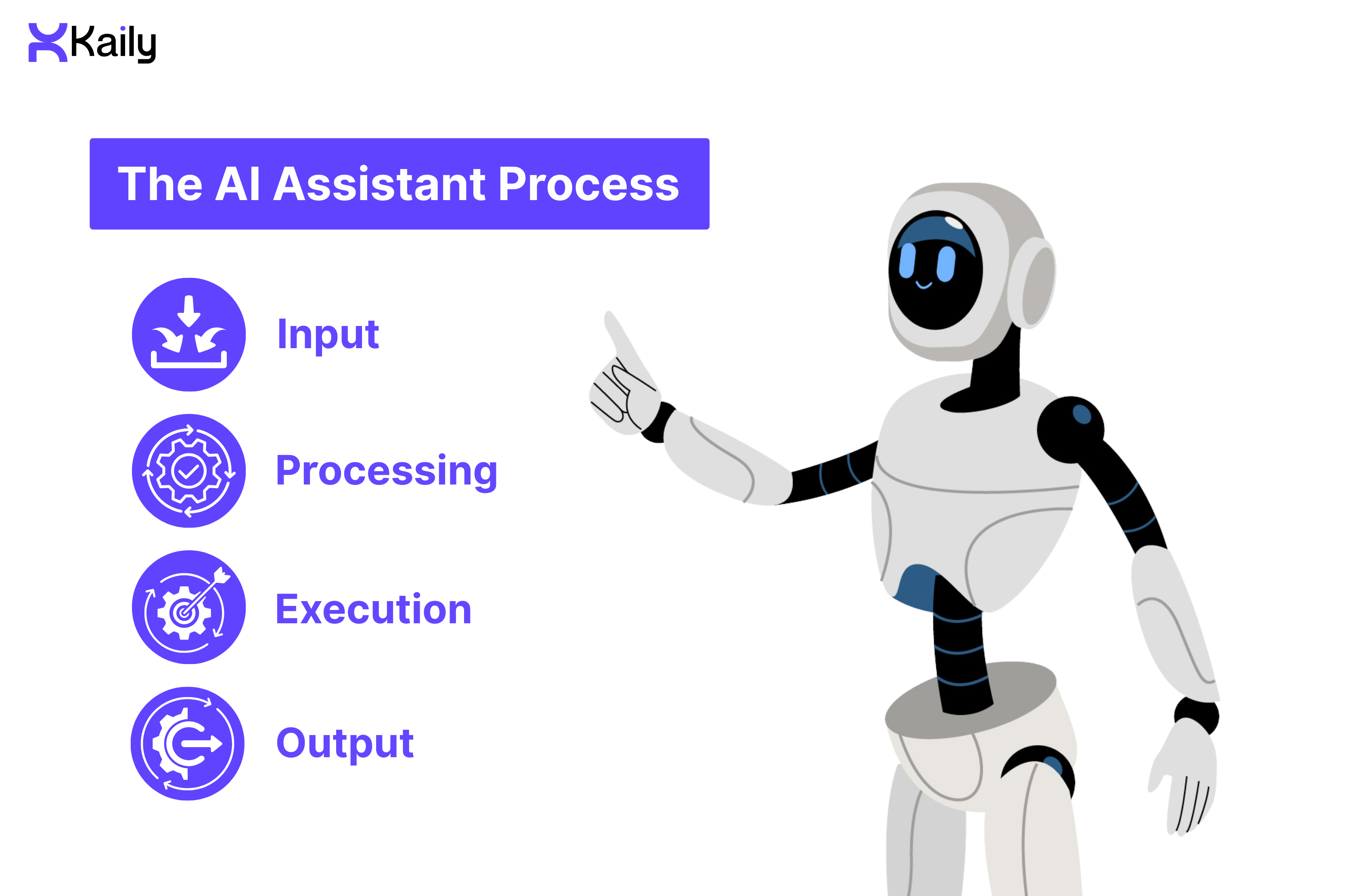
- Phase 1: Input
To begin with, you need to issue a command or prompt to set a meeting or alert via text or voice.
- Phase 2: Processing
Your input or prompt is processed in this phase with the help of natural language processing. This technology helps to understand intent, while machine learning enables the AI assistant to contextualise your input based on its past interactions and accessible data sets.
- Phase 3: Execution
In this phase, the AI assistant executes the task as per the input.
- Phase 4: Output
In the final phase, an AI assistant delivers results through text or speech.
This multilayered processing enables AI assistants to deliver correct and relevant responses. The integration with databases, machine learning, and natural language processing further makes the responses context-rich, which boosts user engagement and satisfaction.
Types of AI Assistants
The types of AI assistants can vary based on their use case and interaction style. The most common types are classified under these categories:
- Task-based Assistants
These AI assistants typically focus on specific functions such as setting reminders, scheduling meetings, managing calendars, and answering basic FAQs. One of the most common examples of task-based assistants would be business chatbots used for customer support.
- Personal AI assistants
These assistants help users with everyday tasks. Amazon's Alexa, Apple's Siri, and Google Gemini are popular personal AI assistants. Data shared by Voice Labs showed that 41% of older adults were using Alexa and 21% were using the Google Assistant in 2021. It shows that the popularity of virtual assistants goes beyond younger generations.
- Conversation-based Assistants
These AI assistants are advanced and designed to facilitate natural dialogues. They support consumer interaction to boost engagement. Sophisticated virtual assistants that handle complex queries come under this category.
- Decision-making Assistants
They help users with data-driven decision processes. These assistants analyse inputs to recommend actions suitable for business intelligence or operational strategy.
- Business AI Assistants
These focus on enterprise workflow processes. They streamline workflow systems, automate routine operations, and enhance productivity.
Based on your needs, you can pick any one of them and streamline your daily tasks and operations.
Key Features of AI Assistants
Top features of an AI assistant include:
- Natural Language Processing: It can understand and help with the generation of human language.
- Machine Learning and Adaptability: It supports continuous improvement and personalisation in each case.
- Integration Capabilities: It can connect with various apps and data sources.
- Voice Recognition: Supports both voice input and output, making AI assistants quite convenient for live user interactions.
- Personalisation: AI assistants personalise responses based on user preferences and interaction history.
- Round-the-clock Assistance: Provides 24/7 access, which helps to optimise resources and responsiveness.
- Multi-tasking: They are adept at handling multiple requests at once without degrading the quality of response.
- Data Security and Privacy: AI assistants come with strong user data protection, which safeguards data and privacy.
- Scope to Scale: They can support expanding demand across a growing user base or organisations.
Benefits of Using AI Assistants

- Saves Time: Free up user bandwidth by taking care of repetitive tasks.
- Saves Money: Reduces labour costs by lowering reliance on human agents and automating routine tasks and queries. Data show that it leads to a 30% reduction in customer service costs.
- Accuracy: Lowers instances of human error in data entry and manual execution.
- Increases productivity: Allows human agents to focus on complex strategic tasks by reducing their administrative workload.
- Improves customer satisfaction: Instant support and practical solutions keep users engaged and satisfied.
- Personalisation: Customised interaction helps boost engagement and promotes loyalty.
- Scalability: Supports businesses in managing high volumes of interaction during the growth phase without adding to costs or delaying responses.
While the benefits are many, it is essential to note the differences between AI assistants and AI agents to get what is best for your needs and how to make the most of their USPs. You can connect with a professional AI agent platform like Kaily to navigate your options and make the best call for your business.
AI Agents vs. AI Assistants
Hence, AI agents like Kaily have higher autonomy and workflow management abilities. On the other hand, AI assistants focus more on executing specific tasks and require more guidance from the users.
Use Cases Across Industries
AI assistants have found application across diverse sectors and industries. Some popular ones we see on a regular basis include:
- Customer Service: AI assistants or chatbots offer users round-the-clock support and handle live queries and FAQs well. They can slash customer care response time by 90%, which makes them a practical upgrade.
- Healthcare: Hospitals and clinics use them to schedule appointments, analyse patient data and even aid diagnostic processes. They use AI assistants to answer patient queries related to Medicare, long-term insurance, and other health-related concerns.
- Banking and Finance: They help detect fraud and assess risk profiles. AI assistants also offer tailored advice based on risks.
- E-commerce: They personalise product recommendations for you.
- Human Resources: The systems are used to automate recruitment and onboarding processes. They help with employee queries in a timely manner.
- Manufacturing: Manufacturing businesses use AI assistants to predict equipment maintenance schedules and manage inventory. It also helps to ensure quality control across different phases of the manufacturing process.
- Education: Many edtech platforms rely on AI assistants for virtual tutoring. Some integrate it into their website and other communication channels to offer users personalised course suggestions.
- Travel: Leading hotels and travel platforms use AI assistants to help plan itineraries, estimate costs and streamline their internal bookings.
Challenges and Limitations
Several gaps hamper user experience despite advancements in AI assistant technologies and wide applications.
For instance, data privacy and security concerns are rampant among both users and enterprises. They need strong security protocols to address them.
Similarly, selective training can lead to data bias, which may trigger unfair or inaccurate responses at times. This overreliance on quality data impacts the performance of AI assistants. Additionally, complex queries can challenge the efficiency of even advanced natural language processing.
Additionally, sophisticated AI systems have high implementation costs, which can deter new or growing businesses from adopting the technology. Integrating with legacy systems can also be challenging, even for established companies. Similarly, maintaining transparency and ensuring ethical use of AI at every stage is difficult for some businesses.
How to Choose the Right AI Assistant?
- Step 1: Define Your Purpose
Understand your business goals first and then set them for the AI assistant to follow. Highlight specific aspects and concerns that you want the AI assistant to address.
- Step 2: Evaluate Features
Assess the quality of natural language processing, automation levels, and scope of integration when comparing AI assistants.
- Step 3: Check Compatibility
Find out whether the AI assistant can connect seamlessly with your existing CRM, data sets, and workflow tools.
- Step 4: Consider Scalability
Don’t forget to plan for growth in terms of user base and evolving service requirements.
- Step 5: Review User Experience
Focus on ease of use and interface design to ensure things are simple for your target users and staff.
- Step 6: Assess Cost
Weigh the cost of ownership and make sure to include licensing and maintenance charges for a more accurate picture.
- Step 7: Security and Compliance
Make sure to verify data protection measures and understand whether they align with global regulations.
- Step 8: Connect with a Trusted AI Platform
A trusted AI platform like Kaily will help you understand whether you need an AI assistant or an advanced AI agent. Their expertise will enable you to plan the subsequent phases smartly and optimise your processes for the long term.
The Future of AI Assistants
Recent data shows that the market size of AI assistants will become USD 4.57 billion in 2025, marking a notable increase from USD 3.62 billion in 2024. It shows how rapidly businesses and individuals are embracing AI assistant technologies. Reports also project that the market will grow to USD 25.88 billion by 2032 as more businesses transition to AI capabilities across various operations.
Amid this phase, these trends are shaping the future of AI assistants:
- Multi-modal capabilities that smartly combine text, voice, and visual interaction
- Personalisation backed by advanced machine learning techniques
- Enhancements in autonomous decision-making and task management
- IoT integration to facilitate smart and connected workplaces and homes
- Cross-platform experiences for seamless connection across devices and systems
- Enhanced emotional intelligence features, like sentiment analysis, to generate empathetic responses
These show that AI assistants are here to stay and shape the future of business operations. As we move towards an automated commercial ecosystem, it is essential to have the right AI tools and support at hand to streamline your transition. Make sure to get to the basics of AI assistants and AI agents before you integrate them with your systems to maximise their use.
In case you have any further questions about AI assistants, feel free to connect with team Kaily.
We would love to hear from you!